Liquidations: understanding ADL and Its role on crypto exchanges
On October 11, 2025, the crypto market experienced the largest single-day liquidation volume in its history – around $19 billion was liquidated in just a few hours. Hyperliquid traders had it the worst: according to CoinGlass data, the platform liquidated $10.3 billion – more than Binance ($2.4 billion) and Bybit ($4.6 billion) combined.
On this page
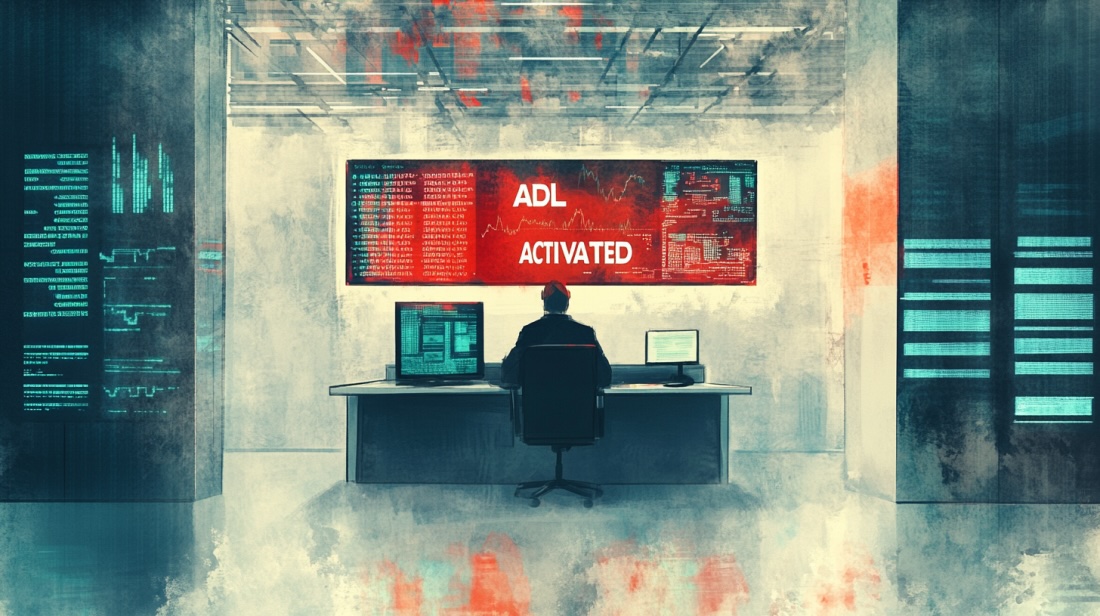
Many Hyperliquid DEX users saw their profitable positions forcibly closed during the event. This happened because of the Auto-Deleveraging (ADL) mechanism, which impacted approximately 35,000 positions across 20,000 traders.
The ADL system automatically closes out positions that are in profit when traders on the opposite side see their account balances turn negative. This prevents the platform from accumulating unrecoverable losses. Anyone holding profitable positions should understand their funds might be tapped to preserve platform-wide security. Traders without any open positions are the sole exception to auto-deleveraging participation.
October 11, 2025, marked the first time in two years that Hyperliquid triggered its ADL mechanism, force-closing profitable positions belonging to 20,000 users. This is not a malfunction; it is a safeguard designed to prevent exchange bankruptcy.
The mechanics of ADL and its purpose
The ADL system works by automatically decreasing the leverage used in a platform's combined position. While this may sound harmless, it results in the forced closure of profitable positions.
Here's the straightforward logic: when a trader's position plunges deep into negative territory and faces liquidation, the exchange must locate a counterparty to close out that position. Typically, this role falls to the insurance fund. However, when losses exceed the fund's capacity, the exchange looks to traders on the winning side – those currently in profit.
Gleb Kostarev, who served as Vice President of Binance for Eastern Europe and CIS between 2018 and 2023, provided this perspective on Hyperliquid's situation:
Yes, of course, Hyperliquid has an ADL mechanism. ADL is the last line of defense for any exchange, even a decentralized one. Hyperliquid has a huge insurance fund of $3.5 billion, but even with that, they must always have additional mechanisms (just in case) that won't allow the exchange to go into the red.
Based on Hyperliquid's documentation, when a user's account balance or isolated position falls below zero, the platform ranks opposing traders according to their unrealized profit and leverage usage.
A higher ranking means faster exposure to potential ADL.
Comparing DEX and CEX: does it matter?
Decentralized exchange advocates frequently emphasize transparency. Their argument: CEX ADL mechanisms operate like black boxes, whereas DEXs make everything visible through smart contracts. From a technical standpoint, this holds true. Every trade on Hyperliquid gets blockchain-recorded and is publicly verifiable.
Kostarev emphasizes the practical point:
This is correct; in this respect, CEXs are not significantly different from DEXs. When your profitable position gets liquidated during a crash, what's the difference in the end?
Rather than an ideological stance, ADL serves as an exchange survival tool. Whether centralized or decentralized becomes irrelevant. When facing potential losses, exchanges will self-protect using user funds. The real variable is activation frequency.
Examining the October crash through Hyperliquid
Since its 2023 launch through October 2025, Hyperliquid maintained a perfect record with zero ADL activations. This track record became a key competitive differentiator. With $3.5 billion sitting in its insurance fund, the platform appeared well-protected. Yet the October 11 downturn proved severe enough to finally trigger the mechanism.
Bitcoin's value plummeted from $126,000 to approximately $104,000 in mere hours. Hyperliquid saw complete liquidation of over one thousand accounts. An additional 6,300+ accounts registered losses exceeding $1.23 billion in total. These figures exclude traders whose profitable positions faced forced closure via ADL.
The affected parties included numerous market makers and quantitative funds managing hedged portfolios. ADL's partial position closures destroyed their hedges, leaving them exposed to subsequent price movements. According to Spencer Hallarn, who heads OTC Trading at GSR, this created “a complex problem” for those running multi-component portfolios.
The inevitability of ADL
Insurance funds have limits. While they grow through collected fees and liquidation profits, extreme market volatility can overwhelm them. Exchanges then face three choices:
- Deploy ADL (automatically closed profitable positions)
- Accept losses (leading to bankruptcy)
- Distribute losses socially (spreading them across all users, even those without positions but holding platform deposits)
Through a risk management lens, option one typically represents the least damaging path. Platforms like Hyperliquid enforce a clear rule: position-less traders don't absorb platform losses. The key point: losses affect only active traders on the opposite side, not all users.
ADL protection strategies
In theory – protection is impossible. Profitable positions with leverage make you an ADL candidate. Practically speaking, risk reduction is achievable through:
- Leverage reduction. Lower leverage equals lower liquidation priority ranking.
- Profit realization. Smaller unrealized gains mean lower ADL formula scoring.
- Platform diversification. Spreading trades across multiple exchanges prevents single-platform total closure.
- Liquidity tracking. High volatility periods see order book volume drops, raising ADL activation likelihood.
The key understanding: ADL represents neither a bug nor manipulation. It's an embedded bankruptcy prevention system. Leverage trading automatically enrolls you in this framework.
Final thoughts
Every major exchange – centralized and decentralized alike – incorporates ADL mechanisms. Transparency marks the sole difference: DEXs expose algorithmic code, while CEXs reveal only outcomes.
Hyperliquid's two-year ADL-free operation demonstrates solid risk management. Yet October's crash proved a fundamental truth: perfect systems don't exist. Even $3.5 billion insurance funds can prove insufficient when markets move with sufficient speed.
Leverage trading inherently risks forced closure – and not exclusively on losing positions. Exchanges prioritize their own solvency, with ADL serving as one protective tool.
Whether executed via smart contracts or not, the financial mechanics remain the same.
The content on The Coinomist is for informational purposes only and should not be interpreted as financial advice. While we strive to provide accurate and up-to-date information, we do not guarantee the accuracy, completeness, or reliability of any content. Neither we accept liability for any errors or omissions in the information provided or for any financial losses incurred as a result of relying on this information. Actions based on this content are at your own risk. Always do your own research and consult a professional. See our Terms, Privacy Policy, and Disclaimers for more details.
Articles by this author