Cassandra Michael Burry: bull market pillars are weakening

The latest essay from Michael Burry argues that the forces supporting equities in the U.S. for decades are no longer moving in favor of the market. This warning centers on passive inflows, buybacks, retirement flows and the belief that policymakers will step in during periods of stress.
Michael Burry has temporarily removed the paywall from one of his recent Substack essays, giving a broader audience access to the framework behind his bearish view on U.S. equities. The piece, titled Foundations: U.S. Market Structure & Value – Powerful Trends, Increasing Fragility & Coiled Tension, reads less like a call on next week’s price action and more like an argument about what has been holding valuations up for years.
At the center of the essay is a simple claim: the market has benefited from several powerful structural tailwinds at the same time, and that combination is no longer as dependable as it once was. Burry’s argument ties together index investing, corporate buybacks, retirement-plan flows and the long-standing assumption that policymakers will step in when markets come under severe pressure.
The support under U.S. stocks looks less stable than before
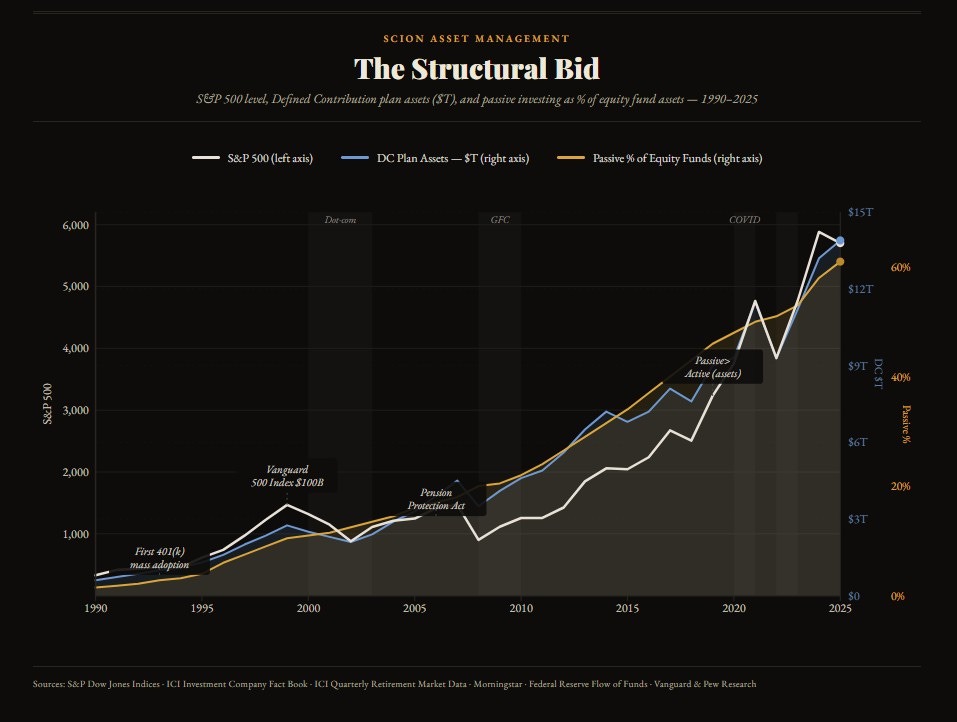
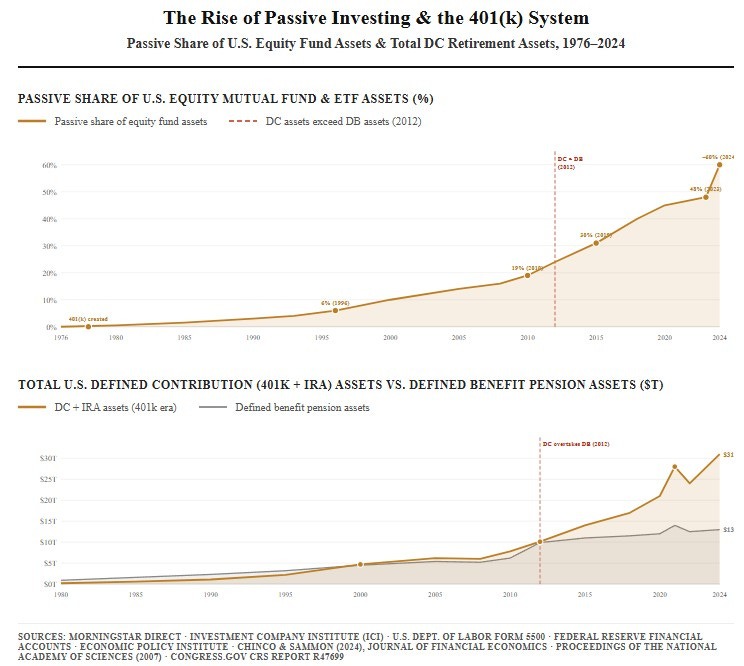
Burry spends much of the essay on passive investing and the way it changes how capital moves through the market. As index funds take a larger share of equity ownership, more money is allocated automatically to benchmark constituents, especially the biggest names. In his telling, that leaves less room for active price discovery and gives the largest stocks continuous support regardless of whether valuations still look compelling on a fundamental basis.
He extends the same logic to buybacks, which have been a major source of demand for U.S. equities for years. His concern is not simply that buybacks may slow, but that they have become concentrated in a relatively small group of companies. If those firms redirect cash and borrowing capacity toward capex, data centers or other investment needs, one of the market’s most dependable demand engines becomes less powerful.
Retirement flows are another part of the framework. Automatic 401(k) contributions from Baby Boomers helped create a steady stream of equity demand over a long period. As that generation moves deeper into retirement, Burry expects the balance to shift gradually away from accumulation and toward drawdowns. That change would not hit all at once, but over time it could remove another layer of structural support.
He also argues that repeated government intervention during crises has shaped investor behavior in lasting ways. Markets that expect some form of rescue during major dislocations tend to tolerate more risk and richer valuations. In Burry’s view, that has made the system more dependent on the belief that a backstop will always be there.
His warning is really about what happens when these forces weaken together
The essay becomes more interesting when these themes are read as one system rather than four separate observations. Passive flows, buybacks, retirement contributions and policy support have all helped reinforce one another. They created an environment in which valuations could remain elevated, concentration could deepen and liquidity could appear abundant for longer than many investors expected.
Burry’s concern is tied to the possibility that several of those supports are now fading at the same time. If that happens, the market may prove less resilient during a broad selloff than headline index levels imply. The issue, in his framing, is not whether every stock suddenly becomes overvalued or untradeable. It is whether investors have become too comfortable assuming that the structure underneath the market will keep absorbing pressure as it did in the past.
That concern connects with a theme Burry has raised for years: markets shaped by heavy passive ownership can look deep and stable in calm conditions while becoming more fragile when money starts moving out quickly. Index-driven inflows can compress dispersion and keep the biggest names well supported on the way up. Under stress, the same concentration may leave fewer natural buyers willing to step in across the market at the same time.
Why his comparison to past shocks is drawing attention
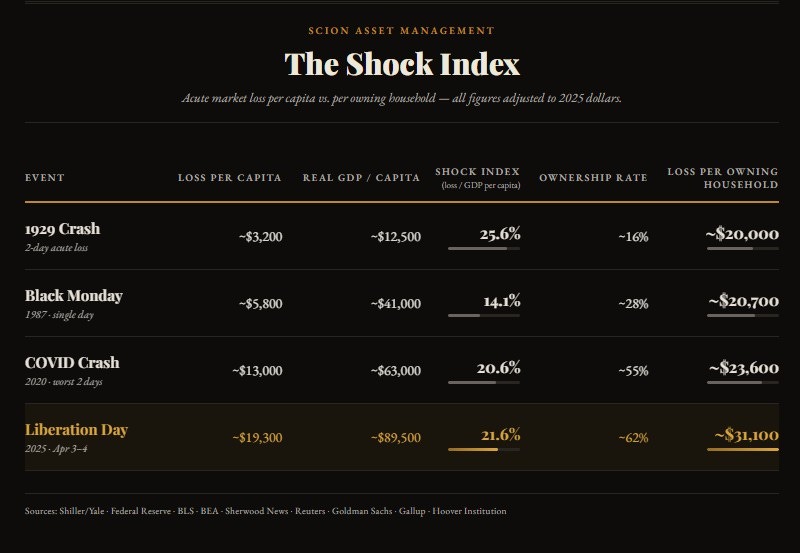
Burry also places the April 2025 tariff-driven selloff in a broader historical frame, comparing its effect with earlier market breaks after adjusting for individual economic output. The goal is to show how violent a modern drawdown can feel even when it falls short of a full-scale financial crisis.
That comparison is meant to highlight sensitivity rather than score a headline-grabbing historical analogy. A market built around the same dominant stocks, the same index flows and the same policy assumptions can react sharply when confidence breaks. In Burry’s reading, fragility builds quietly and then reveals itself quickly.
The strongest part of the essay sits below the headline call
The essay is most useful when read as a structural critique rather than a prediction with a countdown clock attached to it. Burry is asking where demand has been coming from, how concentrated it has become and which assumptions investors have started treating as permanent.
Even readers who do not share his bearish stance can still find value in that framework. The role of passive ownership in price formation, the durability of buybacks, the demographic turn in retirement savings and the market’s reliance on policy support are all serious questions. None of them has to trigger an immediate break to be worth watching closely.
That is also why Burry still draws attention after so many years in the public market conversation. His best-known call before the housing collapse was built on structure, incentives and hidden vulnerabilities long before the wider market was willing to price them in. The current essay follows the same habit of analysis: less interested in short-term sentiment, more focused on the plumbing underneath valuations.
Related: Former Lehman VP warns of 2008-like credit strain in U.S. markets
What readers should take from it
Burry’s latest essay does not have to be read as a precise timing signal to matter. Its real value lies in the way it shifts attention away from daily market noise and toward the forces that have quietly supported U.S. equities for a long time.
His broader point is straightforward. Markets do not stay elevated on optimism alone. They also rely on flows, incentives and policy expectations. If several of those supports weaken together, future selloffs may feel harsher, broader and harder to contain than investors have grown used to.
The content on The Coinomist is for informational purposes only and should not be interpreted as financial advice. While we strive to provide accurate and up-to-date information, we do not guarantee the accuracy, completeness, or reliability of any content. Neither we accept liability for any errors or omissions in the information provided or for any financial losses incurred as a result of relying on this information. Actions based on this content are at your own risk. Always do your own research and consult a professional. See our Terms, Privacy Policy, and Disclaimers for more details.
Articles by this author