Gold hits $5,464 as Middle East burns
Gold was already in record territory before February 28. When US and Israeli strikes hit Iran that morning, traders responded the way they always do when a major war breaks out in the Middle East: they bought gold.
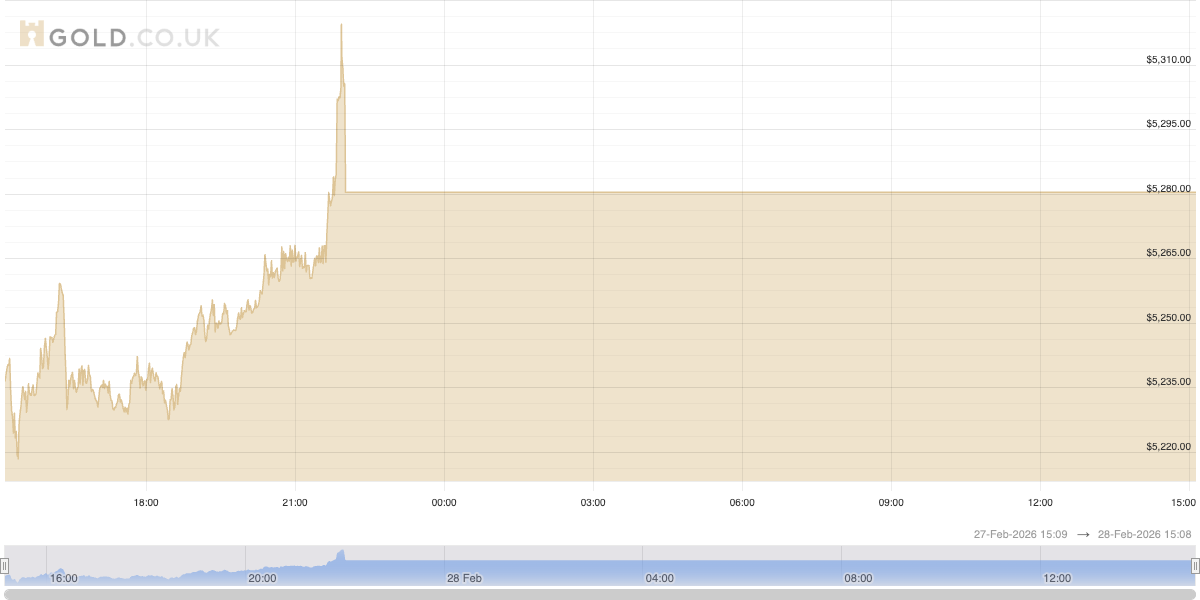
On Saturday, as explosions hit Tehran, Isfahan, Tabriz, and Qom, mainstream markets closed for the weekend, but Gold had surged past $5,464 per troy ounce, and Silver jumped over 8%. Analysts who had been watching the $5,300 COMEX resistance level for weeks suddenly found themselves discussing $6,000 as a realistic near-term target.
Why Gold responds to this kind of event
The relationship between Middle East conflict and gold prices is mechanical. Three channels drive it simultaneously.
1. Direct safe-haven demand. When geopolitical risk spikes suddenly, institutional investors reduce exposure to equities and currencies and move into assets that hold value independently of any particular government or financial system. Gold has served that function for centuries and continues to do so.
2. The channel runs through oil. A conflict that threatens Persian Gulf shipping – particularly the Strait of Hormuz – raises the prospect of energy price spikes, which feed into inflation expectations. When inflation expectations rise, real yields on government bonds fall. Lower real yields make gold more attractive relative to yield-bearing assets. The sequence from “military strike” to “gold buying” runs through oil prices and bond math.
3. Currency debasement hedging. If a supply shock drives up energy costs while governments respond with fiscal stimulus, the purchasing power of fiat currencies comes under pressure. Gold is the traditional hedge against that scenario. As one analyst noted, if the Strait of Hormuz is disrupted, “investors buy gold today to hedge against the future loss of purchasing power.”
Where prices were before the strikes
Gold had already been trending upward through early 2026, supported by central bank buying across multiple countries and persistent uncertainty about US monetary policy. The metal was approaching the $5,300 per ounce level on COMEX – itself a record – before February 28.
The Iran strikes didn't find gold at a low, but they hit a market already in a structurally bullish position, where any additional catalyst was likely to produce outsized moves. The $5,464 level represents roughly a 3% move above pre-strike levels in a single session.
What Monday's open could bring
Mainstream commodity markets – COMEX in New York, the London Bullion Market – reopen Monday. But they suggest the gap-up opening that analysts were anticipating is likely.
The key technical level to watch is $5,300 on COMEX. Several analysts had identified this as resistance before the strikes. If Monday's open pushes through it decisively, the next targets analysts cite are in the $5,500–$5,600 range, with $6,000 per ounce now discussed as a credible medium-term scenario if the conflict expands or if Iran acts on threats to close the Strait of Hormuz.
Silver is moving in the same direction but more aggressively. The metal's dual role as both a safe-haven asset and an industrial commodity – demand for it runs through electronics, solar panels, and manufacturing – means it typically amplifies gold moves in both directions during risk events.
Reading the bigger picture for Gold
Gold rarely moves in isolation. Monday's session will also be shaped by what happens to equities, the dollar, and oil simultaneously. Historically, sharp equity sell-offs during geopolitical crises can force institutional investors to liquidate gold positions to cover losses elsewhere – a dynamic that can briefly suppress gold prices even during genuine risk events, before safe-haven demand reasserts.
The dollar's reaction matters too. Gold is priced in dollars, and a dollar rally following a risk-off event can offset some of gold's gains in USD terms, even as it rises in local currency terms in other markets. Indian markets, which were already seeing record domestic gold prices before February 28, would feel this dynamic acutely.
What's different about this episode compared to previous Middle East escalations is scale. US “major combat operations” against Iran are not a targeted strike on a proxy or a single facility. Markets are pricing a scenario where the conflict doesn't de-escalate quickly – and gold's behavior suggests traders aren't assuming a resolution is imminent.
The $6,000 per ounce figure that analysts are now invoking publicly wasn't on anyone's near-term price target list 48 hours ago.
The content on The Coinomist is for informational purposes only and should not be interpreted as financial advice. While we strive to provide accurate and up-to-date information, we do not guarantee the accuracy, completeness, or reliability of any content. Neither we accept liability for any errors or omissions in the information provided or for any financial losses incurred as a result of relying on this information. Actions based on this content are at your own risk. Always do your own research and consult a professional. See our Terms, Privacy Policy, and Disclaimers for more details.
Tags
Articles by this author