Oil markets on edge as US and Israel strike Iran
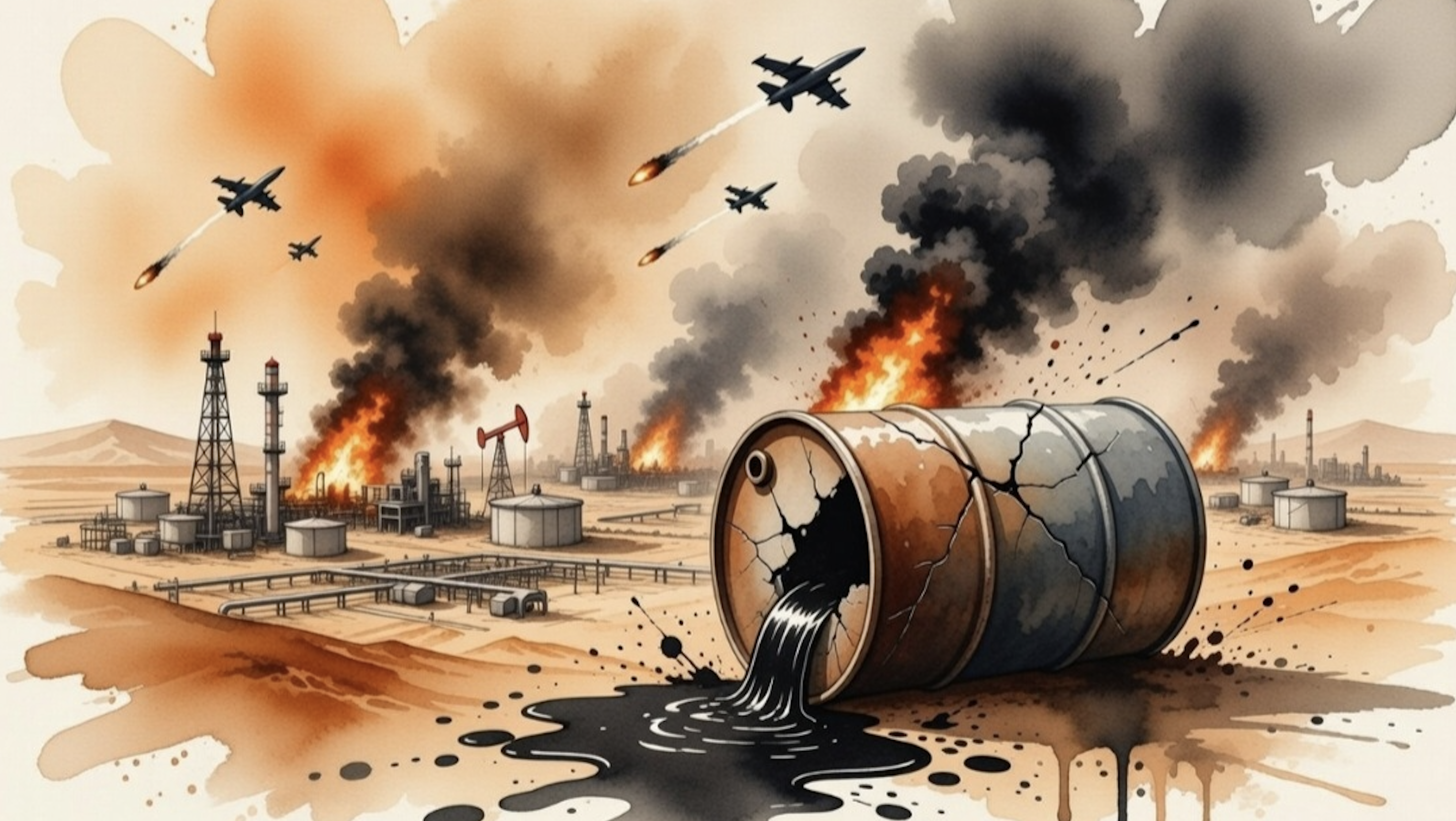
On February 28, the United States and Israel launched coordinated military strikes on Iran – targeting Tehran, Isfahan, Tabriz, Qom, and several other cities. Oil markets had been pricing in this risk for weeks. Now the scenario is no longer theoretical.
Trump confirmed the operation in a video address, describing it as “major combat operations” aimed at dismantling Iran's ballistic missile industry and preventing nuclear weapons development.
Iranian state media confirmed that President Masoud Pezeshkian is in good health. Supreme Leader Khamenei's status remains unclear – Iranian state media insists he is safe, while Israeli assessments suggest he may have been evacuated to an underground bunker before strikes hit his compound. Several senior IRGC commanders were reportedly killed in the initial wave.
Iran's weight in global oil supply
Iran produces approximately 3.1 million barrels of crude per day, according to OPEC. That places it comfortably inside the world's top ten producers – though well below its peak. In 1974, Iran was the third-largest producer globally after the US and Saudi Arabia, pumping around six million barrels daily. Decades of US sanctions, beginning after the 1979 revolution and intensified under Trump's “maximum pressure” policy during both his first and second terms, cut that output nearly in half.
What Iran lacks in volume, it partly compensates for in cost efficiency. Production costs run as low as $10 per barrel – comparable to Saudi Arabia, Iraq, Kuwait, and the UAE, and far below the $40-60 per barrel typical of US or Canadian operations. That makes Iranian crude disproportionately profitable at high global prices, and gives the country significant financial incentive to maintain output even under pressure.
Iran is also believed to hold the world's third-largest crude reserves, a long-term strategic factor that outlasts any particular government.
The Strait of Hormuz: The actual risk
The immediate concern for global markets isn't Iran's own production – it's the Strait of Hormuz.
This narrow waterway, roughly 50 kilometers wide and no deeper than 60 meters, connects the Persian Gulf to the Gulf of Oman. In 2024, approximately 20 million barrels of crude oil passed through it daily, according to the US Energy Information Administration — nearly 20% of global liquid oil consumption. The oil exports of Saudi Arabia, the UAE, Kuwait, Iraq, and Iran itself all pass through this chokepoint.
Iran has threatened to close the strait repeatedly over decades. Whether it acts on that threat now depends on how the military situation develops, but markets don't wait for confirmation. As Arne Lohmann Rasmussen of Global Risk Management noted:
“Even a doubt about security in the Strait would prompt many vessels, for insurance reasons, to face difficulties transiting, as premiums would rise sharply.”
The bypass alternatives are limited. Only Saudi Arabia and the UAE have meaningful infrastructure to route oil around the strait, and that capacity maxes out at around 2.6 million barrels per day – enough to partially offset disruption, not absorb a full closure.
Iran's oil customers
US sanctions have already reshaped where Iranian crude goes. Between 1.3 and 1.5 million barrels leave Iran daily, with more than 80% bound for Chinese refineries. Beijing buys at below-market prices specifically because no one else will – the discount compensates for the sanctions risk that Chinese “teapot” refineries, independent of state oil companies, absorb.
Washington targeted those teapot refineries last year in an effort to tighten the squeeze. China continued buying anyway. Military strikes change the calculus differently: the question is no longer whether buyers face sanctions penalties, but whether the supply can physically be loaded and shipped while strikes continue.
Neighboring countries and regional infrastructure
Iran's neighbors have reason for concern beyond oil exports. Gulf states, Turkey, and Pakistan all host US military installations – making them potential targets for Iranian retaliation. Pierre Razoux of the Mediterranean Foundation for Strategic Studies noted that Iran retains enough intermediate-range missiles to strike critical infrastructure across the region, including hydrocarbon hubs, power plants, and desalination facilities.
A strike on Gulf energy infrastructure would compound the market disruption well beyond Iranian output.
What this means for prices
Crude reaching $100 per barrel has been floated as a realistic scenario if the Strait of Hormuz is disrupted even partially. That level hasn't been seen since the early weeks of Russia's invasion of Ukraine in February 2022.
For Trump, the timing carries political weight. He has repeatedly promised American voters cheaper energy. A sustained spike in oil prices – driven by a military operation he ordered – complicates that narrative ahead of midterm elections at the end of the year.
For the global economy, an oil shock layered on top of existing inflation pressures represents a compounding risk that central banks have limited tools to address quickly.
Markets were watching the Strait on February 28. Nothing suggests they’ll stop anytime soon.
The content on The Coinomist is for informational purposes only and should not be interpreted as financial advice. While we strive to provide accurate and up-to-date information, we do not guarantee the accuracy, completeness, or reliability of any content. Neither we accept liability for any errors or omissions in the information provided or for any financial losses incurred as a result of relying on this information. Actions based on this content are at your own risk. Always do your own research and consult a professional. See our Terms, Privacy Policy, and Disclaimers for more details.
Tags
Articles by this author