Goldman lifts U.S. recession odds to 30% on oil shock

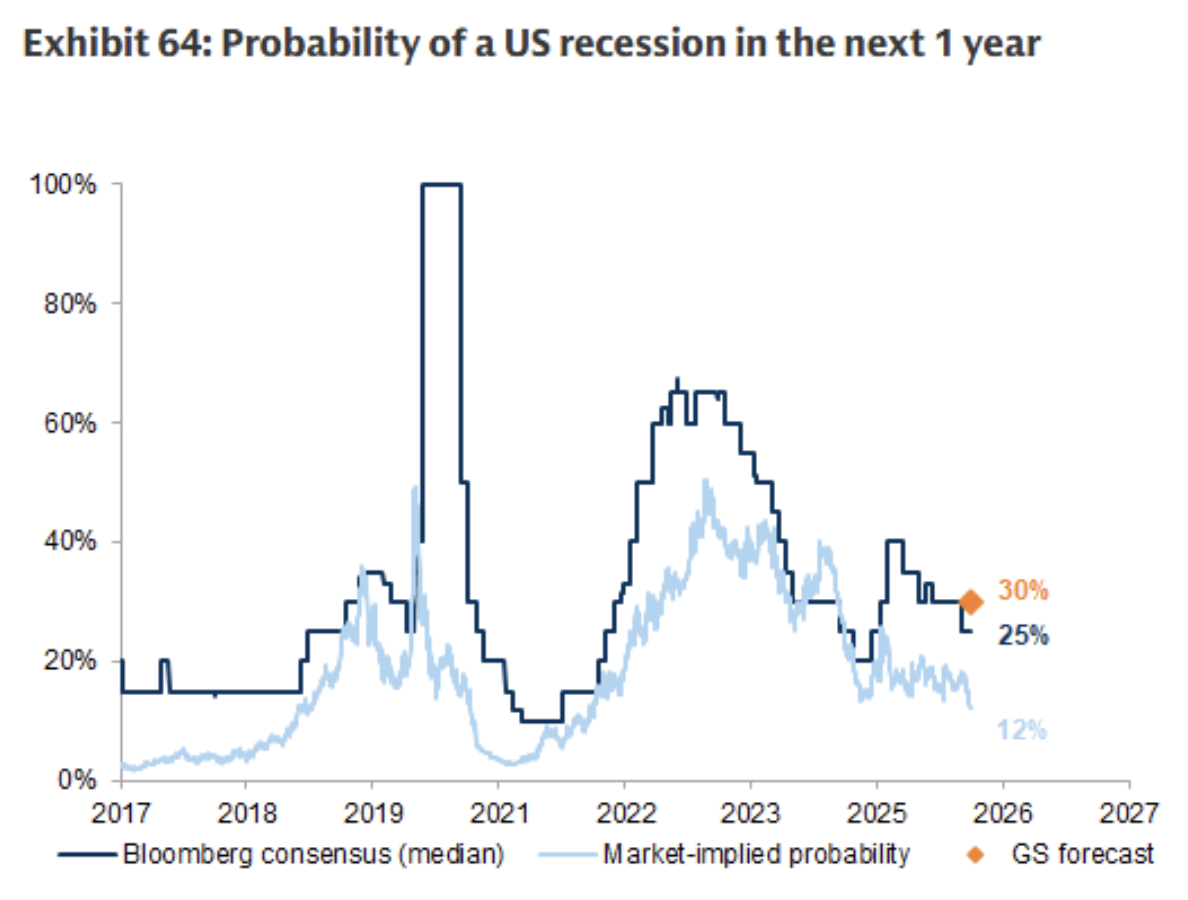
Goldman Sachs raised the odds of a U.S. recession to 30% from 25%, citing a Middle East-linked oil shock, slower growth, a softer labor market, and fading fiscal support.
Goldman Sachs raised its U.S. recession probability to 30% from 25% in its latest outlook, pointing to an oil shock tied to Middle East tensions, slower growth, a softening labor market, and waning fiscal support. The firm indicated that risk estimates were closer to 20% only weeks ago and still puts the chance of avoiding a downturn later this year at 70%.
Energy prices have climbed. Brent crude rose from about $71 a barrel at the start of the conflict involving Iran to roughly $101 after briefly topping $110, a jump that tends to lift inflation and erode purchasing power.
Recent U.S. data reflect a cooler backdrop. Real GDP grew at a 0.7% annualized rate in the fourth quarter of 2025. In February, nonfarm payrolls fell by 92,000 and the unemployment rate reached 4.5%. February CPI increased 2.4% from a year earlier; the latest headline PCE reading was 2.8%, and core PCE stood at 3.1% in January.
Goldman expects growth to slow to roughly 1.25% to 1.75% in the second half of 2026, a pace it describes as near stall speed. Its economists project unemployment around 4.6% as hiring hovers near breakeven.
Higher energy costs complicate the Federal Reserve’s path. Rate cuts would normally support growth, yet elevated inflation narrows that option. Large federal deficits also limit fiscal support, with U.S. debt around $39 trillion. Goldman still anticipates the Fed will begin lowering rates in the second half of the year.
Other forecasters have become more cautious. JPMorgan puts the odds of a U.S. recession at 35%. Moody’s Analytics chief economist Mark Zandi places the risk at 49%, and EY-Parthenon’s Gregory Daco estimates 40%. Morgan Stanley shifted its expected first Fed rate cut to September from June, citing softer activity and labor indicators. Bank of America warned that a prolonged energy shock could create a larger drag on growth.
Goldman also highlights supply risks around the Strait of Hormuz that could keep Brent near or above $100, adding cost pressure for businesses and households. It notes that the lift from earlier tax cuts and federal spending is fading as those effects roll off.
The outlook follows a policy shift that began in 2022, when the Fed raised rates after a period of near-zero borrowing costs and large pandemic stimulus. That earlier support aided a rapid rebound but coincided with sticky inflation. Past energy spikes have strained expansions while keeping prices elevated, including the 1973 to 1975 recession.
The content on The Coinomist is for informational purposes only and should not be interpreted as financial advice. While we strive to provide accurate and up-to-date information, we do not guarantee the accuracy, completeness, or reliability of any content. Neither we accept liability for any errors or omissions in the information provided or for any financial losses incurred as a result of relying on this information. Actions based on this content are at your own risk. Always do your own research and consult a professional. See our Terms, Privacy Policy, and Disclaimers for more details.
Articles by this author