

BTCC Crypto Exchange Review 2026: Testing Fees, Features and Safety
Affiliate Disclosure:
The Coinomist publishes reviews and ratings produced by GNcrypto as part of a content partnership. GNcrypto’s editorial team tests platforms independently using real funds. If you click on affiliate links, GNcrypto may earn commissions, which support their testing infrastructure. All opinions, ratings, and assessments are GNcrypto’s. The Coinomist does not influence evaluations and may not share these views.
BTCC

BTCC works for traders who want derivatives-first platform with spot as secondary – perpetual futures up to 500x leverage, demo mode, and copy trading. Check supported regions and payment methods before depositing – fiat options are limited and third-party fees add 3–5%.
GNcrypto's Verdict

BTCC has operated since 2011 as a centralized crypto platform with a strong focus on derivatives. Its core product is perpetual futures with leverage of up to 500x. The platform also offers spot trading, copy trading, a demo mode, and an API for automation. For transparency, BTCC publishes monthly Proof of Reserves reports with Merkle-tree verification (September 2025 report showed 143% reserve ratio). Spot trading fees are 0.2% (maker) and 0.3% (taker) – fixed, no volume discounts on spot.
- Established CEX (launched in 2011)
- Solid spot turnover (~$1.5B per 24h)
- Merkle-tree Proof of Reserves
- High base spot fees at entry level
- No spot-fee discounts
- Fiat purchases limited to USDT
On this page
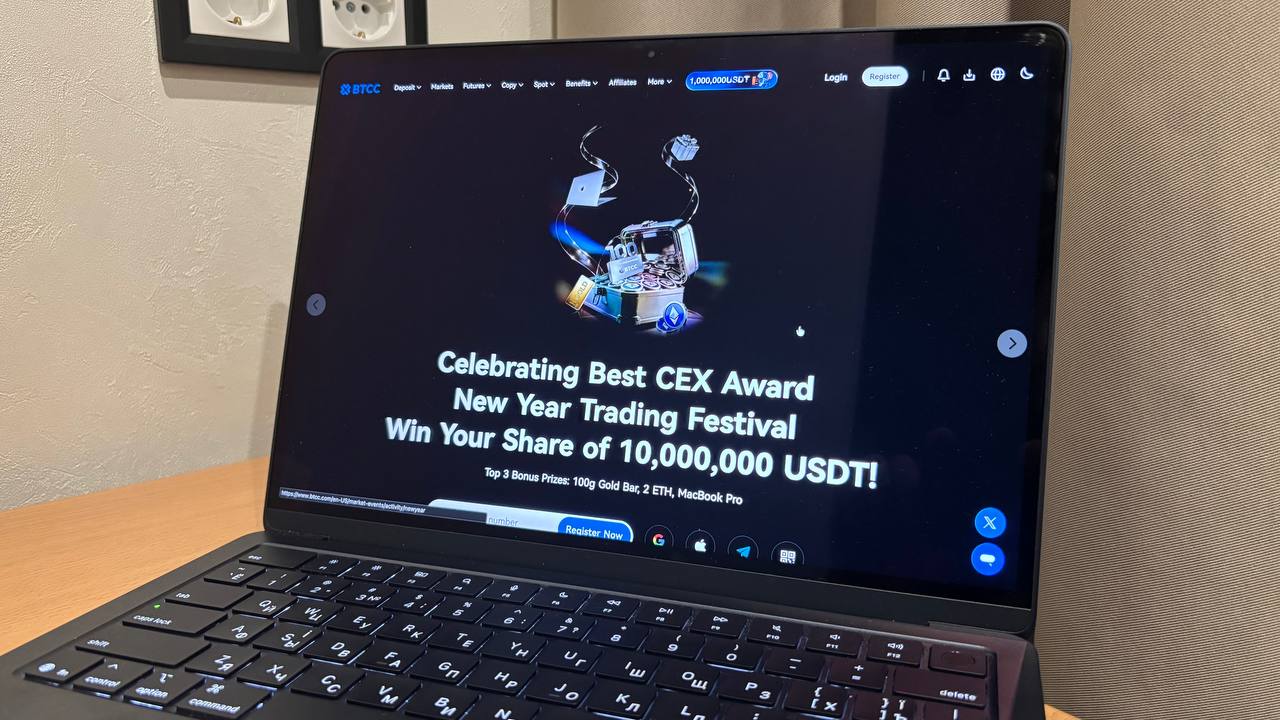
GNcrypto’s analysts tested BTCC to assess costs, market quality, and day-to-day usability. They reviewed spot and futures fees, funding mechanics, core tools like demo and copy trading, proof of reserves reporting, and basic security signals, then summarized who the platform fits best in 2026.
BTCC pros and cons
This BTCC exchange review focuses on day-to-day trading: what works, what doesn't, and who fits. Derivatives dominate – perpetual futures up to 500x leverage are the main draw. Demo mode lets traders test strategies risk-free before committing real funds. Monthly Merkle-tree proofs let users verify their balance inclusion against published reserves.
Strengths:
- Strong focus on derivatives: perpetual futures with leverage up to 500x.
- Proof of Reserves using a Merkle tree – monthly snapshots, September 2025 showed 143% ratio (users can verify their balance inclusion).
- Demo trading for testing strategies without real funds.
- Copy trading to mirror the positions of selected traders.
- Transparent spot fees without a complex tier structure: 0.2% maker and 0.3% taker.
Weaknesses:
- Leverage up to 500x greatly increases risk: a 0.2% price move against you at 500x liquidates the position – small mistakes scale as fast as gains.
- Spot trading fees are not the most competitive: 0.2%/0.3% stay fixed regardless of volume – Binance and OKX offer 0.1%/0.1% at base tier.
- Proof of Reserves is a snapshot at a single point in time – it should be viewed as a report, not an ongoing guarantee.
Fees and Costs
BTCC charges trading fees and network fees. On spot markets, the base rates are 0.2% (maker) and 0.3% (taker). Perpetual futures: 0.03% maker / 0.06% taker (can drop to 0.02%/0.04% at higher VIP tiers based on 30-day volume). Funding fee is charged every 8 hours – rate varies by market conditions, typically ranges from -0.05% to +0.05% (check current rate before opening positions).
Crypto deposits are free (no BTCC fee, but network fees apply when sending from an external wallet). Fiat purchases run through third-party payment providers (Simplex, Banxa) – expect 3–5% processing fees on top of BTCC's rates, final cost depends on method and region. Withdrawals process on-chain – BTC withdrawal fee typically 0.0005 BTC, ETH 0.005 ETH (varies by network congestion, shown before confirmation). Direct fiat withdrawals via card or bank transfer may not be available, so it’s worth checking which methods your country supports before depositing.
Is BTCC legit? Fee transparency is one signal: published spot/futures schedules, funding rate history, withdrawal fees shown upfront – GNcrypto found no hidden charges during testing.
Final Verdict
BTCC focuses on futures trading with a clean interface – no clutter, no overwhelming feature lists. Perfect for traders who want derivatives tools without the noise, as this BTCC exchange review confirms through hands-on testing. Its core product is perpetual futures with leverage up to 500x, supplemented by a demo mode, copy trading, and an API – tools suited for strategy testing and automation. This makes BTCC a better fit for experienced traders who understand leverage risk and know how to manage position size.
BTCC doesn't fit low-cost spot traders – 0.2%/0.3% fees are 2–3x Binance's 0.1%/0.1%. Fiat onboarding runs through third-party providers (Simplex, Banxa), adding 3–5% fees – higher than exchanges with direct bank integrations like Kraken or Coinbase. Withdrawals are usually processed on-chain and depend on the network fees of the chosen asset.
If you need futures with high leverage, demo mode, and copy trading, BTCC works. If your priority is minimal spot fees and broad asset variety, BTCC may not be the best fit.
Who BTCC fits: derivatives traders testing high-leverage strategies (100x–500x), users who want demo mode for risk-free practice, traders copying strategies via copy trading, API users automating futures positions.
Who should skip: spot-only traders seeking low fees (0.2%/0.3% vs. competitors' 0.1%/0.1%), users needing 500+ altcoin pairs, anyone uncomfortable with extreme leverage risk – at 500x, 0.2% adverse move = full liquidation.
Trustworthiness check
Public facts on BTCC's regulation, reserves, and security:
- February 16, 2017. BTCC temporarily suspended crypto withdrawals (Feb 16 – Mar 15) during China's regulatory crackdown, citing compliance upgrades. Fiat withdrawals remained available, and the company said crypto withdrawals would resume once the updates were complete.
- September 16, 2025. BTCC support materials outlined common fraud schemes, including phishing sites posing as BTCC and fake applications containing trojans that can alter deposit and withdrawal addresses. Users are advised to rely only on official channels for downloading and updating the app.
- September 25, 2025. BTCC released its September 2025 Proof of Reserves report: 143% overall reserve ratio as of September 15 (BTC reserves: 111%, ETH: 152%, USDT: 156%). The report breaks down holdings by major assets – reserves exceed customer balances across all listed cryptocurrencies.
GNcrypto's Overall BTCC Rating
| Criteria | Rating (out of 5) |
|---|---|
| Liquidity & Volume | 4 |
| Fees & Total Cost to Trade | 3 |
| Asset Selection & Trading Pairs | 4 |
| Execution Quality / Market Quality | 4 |
| Tools & Order Controls | 4 |
| Fiat Access & Minimum Trade Size | 4 |
| Reliability & Transparency | 4 |
| Total Score | 3.8 |
Methodology – Why You Should Trust GNcrypto Reviews
GNcrypto’s testing team uses a weighted, category-based model, collects standardized data from each platform (open data + hands-on testing), and converts that into a 1.0–5.0 star score in 0.1 increments.
Testers focus is spot trading quality: real fees, minimum trade size, crypto availability, market quality, and the user-facing experience.
How GNcrypto Collect Data
– Public sources: fee schedules, supported asset/pair lists, proof‑of‑reserves or reserve disclosures, and system status pages.
– First-hand testing: team place test spot trades, observe effective fees (fee + spread), measure slippage/spreads on majors, and evaluate UI speed and order controls.
GNcrypto’s experts do not rate solvency or make guarantees about financial stability. These ratings reflect user experience, access, and trading quality – not a balance‑sheet audit.
Categories & Weights
– Liquidity & Volume – 25%
– Fees & Total Cost to Trade – 25%
– Asset Selection & Trading Pairs – 15%
– Execution Quality (Market Quality) – 10%
– Tools & Order Controls – 10%
– Fiat Access & Minimum Trade Size – 5%
– Reliability & Transparency – 10%
Latest News





Recommended Articles/Reviews






The content on The Coinomist is for informational purposes only and should not be interpreted as financial advice. While we strive to provide accurate and up-to-date information, we do not guarantee the accuracy, completeness, or reliability of any content. Neither we accept liability for any errors or omissions in the information provided or for any financial losses incurred as a result of relying on this information. Actions based on this content are at your own risk. Always do your own research and consult a professional. See our Terms, Privacy Policy, and Disclaimers for more details.
