

KuCoin Exchange Reviews 2026: Fees, Safety, and Real Trading Conditions
Affiliate Disclosure:
The Coinomist publishes reviews and ratings produced by GNcrypto as part of a content partnership. GNcrypto’s editorial team tests platforms independently using real funds. If you click on affiliate links, GNcrypto may earn commissions, which support their testing infrastructure. All opinions, ratings, and assessments are GNcrypto’s. The Coinomist does not influence evaluations and may not share these views.
KuCoin

KuCoin is a strong pick for active spot traders who want low base fees, broad altcoin coverage, and built-in tools like futures and trading bots, but past security incidents and incomplete global licensing mean large, long-term balances are safer in self-custody.
GNcrypto’s Verdict

KuCoin is a centralized exchange for traders outside the U.S., offering low spot fees, deep liquidity, and a broad selection of altcoins. In GNcrypto’s tests, spot limit and market orders executed quickly, spreads on major pairs stayed tight, and futures trading offered leverage up to 100x.
- Base spot fees are 0.1% maker / 0.1% taker, with discounts for higher volume and paying with KCS.
- Strong liquidity on major pairs: KuCoin’s daily spot volume is around $1-2 billion, and spreads on BTC/USDT and ETH/USDT stayed under 0.02% during normal conditions.
- Broad asset selection: more than 800 coins and over 1,300 trading pairs, including early listings and low-liquidity altcoins.
- The platform is officially unavailable to U.S. residents and users in several other jurisdictions, and accounts from restricted jurisdictions face blocks.
- Withdrawal fees depend on the selected network and current network load, with the final amount confirmed only at the transaction confirmation step.
On this page
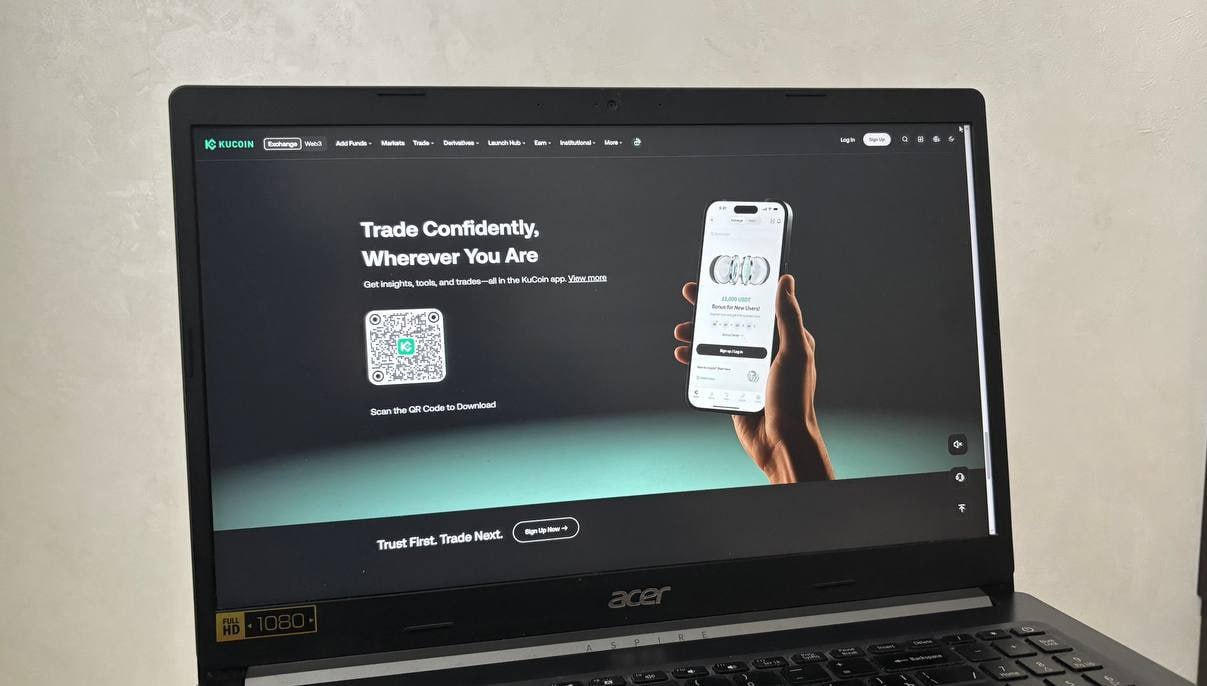
KuCoin lists 800+ coins across 1,300+ trading pairs, making it one of the top 10 exchanges by altcoin selection, with low base fees, deep futures markets, and copy-trading tools aimed at active retail traders.
For this review, the GNcrypto team created a separate KuCoin account, completed KYC, funded it with $200, and traded like a regular user. We checked how quickly deposits were credited, how limit and market orders worked, how stable the terminal was under load, and how spreads behaved at different times of day.
We also looked at order book depth for BTC/USDT, ETH/USDT, and several popular altcoins, and measured price impact across different trade sizes.
GNcrypto testers also reviewed the fee structure, how KCS discounts work, the terms for margin and futures trading, and how account security and withdrawals are handled.
KuCoin at a Glance: Platform Scope and Market Role
KuCoin launched in 2017 and targets global retail and professional trading. The platform serves over 40 million users across 200+ countries and offers access to 1,000+ cryptocurrencies and roughly 1,800 spot and derivatives pairs, including BTC, ETH, stablecoins, and low-liquidity altcoins.
KuCoin’s daily spot volume hovers around $2 billion, and combined spot + derivatives volume often exceeds $3-4 billion, keeping the exchange in the global top 10 CEX by trading volume.
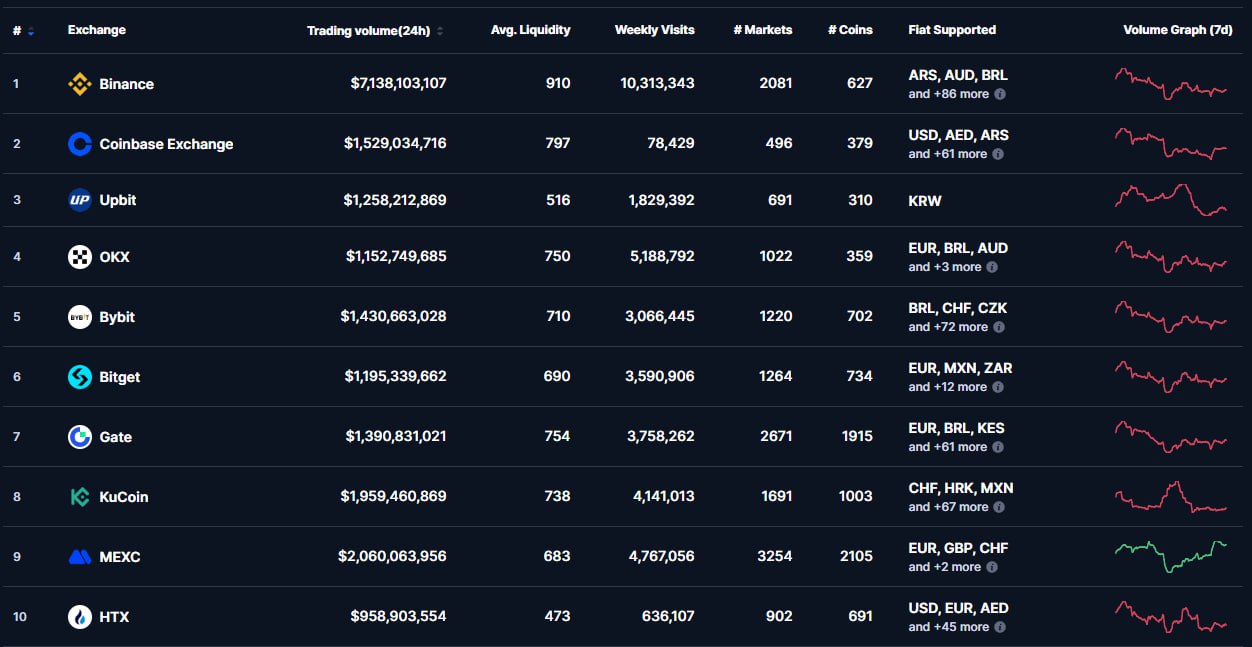
Based on this and other KuCoin exchange reviews from the GNcrypto team, the platform is positioned as a venue for finding unique, high-upside tokens and actively trading derivatives.
This comes down to a broad product lineup: margin trading up to 10x, futures with leverage up to 125x, options, a P2P market, earn products, and the KCS token, which offers reduced fees.
Test results
We created a KuCoin account and ran spot trades to verify execution quality and fee structure.
Registration & KYC:
- Account creation: 2 minutes (email + SMS verification)
- KYC (Level 1): 18 minutes (passport + selfie)
- Deposit: 200 USDT via TRC-20, arrived in 6 minutes (12 confirmations)
BTC/USDT spot trade ($100 market buy):
- Order placed: 10:15 UTC
- Expected fill: $67,200
- Actual fill: $67,215 (0.016% slippage)
- Fee: $0.20 (0.1% taker)
- Total cost: $0.23 (0.12%)
Observation: slippage was minimal (0.016%) thanks to a deep order book. During volatile hours (6% BTC spike on day 2), spread widened from 0.01% to 0.08%, but fills remained under 2 seconds.
ETH/USDT limit order ($100, maker):
- Order placed at $1,850
- Filled in 8 minutes
- Fee: $0.10 (0.1% maker)
Low-cap altcoin test (SOL/USDT, $50 market buy):
- Slippage: 0.35%
- Fee: $0.05 (0.1%)
- Total: 0.45%
Observation: Mid-cap and major pairs execute cleanly. Low-cap pairs show wider spreads – use limit orders.
Friction points:
- Withdrawal fee not shown upfront – only visible at confirmation step (USDT TRC-20: 1 USDT)
- P2P fiat options unavailable in EU (tested from Germany)
- Futures terminal showed “upgrade KYC” prompt despite Level 1 completed (resolved after refresh)
KuCoin Trading Tools and Feature Set
KuCoin offers a full suite of tools for active trading. The spot terminal supports 900+ coins and 1,200+ trading pairs, including major BTC/USDT and ETH/USDT markets as well as niche altcoins. For margin trading, both cross and isolated margin are available, and the futures section supports perpetual and dated contracts with leverage up to 100x and a standard set of order types: limit, market, stop-limit, and stop-market.
Charts run on TradingView, so familiar indicators and annotations carry over directly in the terminal.
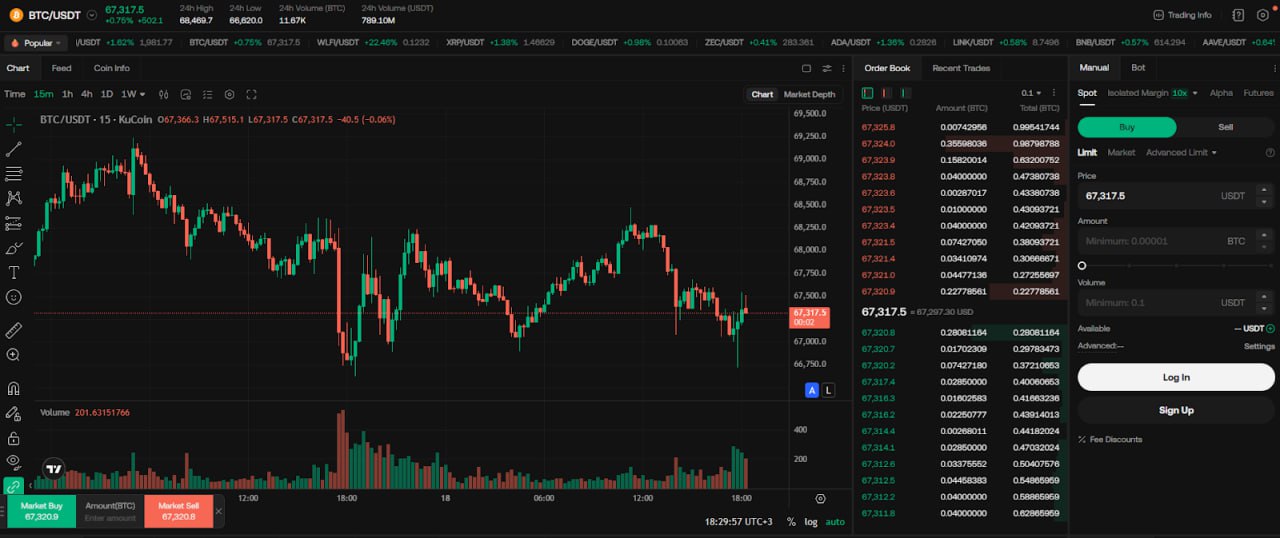
KuCoin also expands its lineup with additional tools: built-in spot and futures trading bots, futures copy trading, P2P exchange, a no-slippage converter, and an Earn section with staking, lending, and fixed-yield subscriptions.
You can manage all of this from a single interface in both the browser and the app. That’s why, in this KuCoin reviews, GNcrypto traders focused not only on fees but also on tool coverage: as a result, the platform met the needs of both manual trading and semi-automated strategies.
Should You Use KuCoin?
KuCoin makes sense for traders who actively trade altcoins and futures at mid-size volume – $10,000+ per day – run scalping or intraday strategies, and want access to hundreds of pairs in a single order book.
For this audience, the question is KuCoin legit hardly comes up: the exchange offers deep books in major markets, a robust margin and futures stack, bots, and advanced order types; top-tier U.S. or EU regulatory frameworks matter less to traders in this segment.
That makes it a poor fit for large funds, conservative holders with six-figure deposits, and anyone who prioritizes local licensing. Those users should look to more regulated crypto exchanges.
Pros, Cons & Limitations
How KuCoin compares to other centralized exchanges in daily use:
Strengths:
- Derivatives lineup executed cleanly in our test: BTC perpetual with 10x leverage filled with 0.02% slippage, futures bot launched in under 3 minutes. A trader running a grid bot on ETH perpetuals (5x leverage, 1% spacing) over 7 days completed 42 cycles with total fees of $8.40 vs $16.80 on a 0.2% exchange – the 0.1% base rate compounds quickly at high frequency.
- Strong volume metrics reduce slippage on majors: our BTC market order filled with 0.016% slippage vs 0.12% on a smaller exchange. Total annual trading volume exceeded $1 trillion, keeping BTC/USDT and ETH/USDT spreads under 0.02% even during 6% price spikes.
- The native KCS token reduces fees from 0.1% to 0.08% at the first tier (hold 10 KCS, roughly $100 at current prices). A trader doing $50,000 monthly volume saves $10/month at this tier, or $120 annually – enough to offset the KCS holding cost if the token remains stable.
Weaknesses:
- The 2020 hack ($280M from hot wallets) remains a practical concern for custody strategy. Example risk scenario: a trader keeping $50,000 on-exchange for active futures trading faces tail risk if another hot-wallet breach occurs. Mitigation: move profits to self-custody weekly, keep only working capital on-exchange (2-4 weeks of typical volume), and enable withdrawal whitelisting.
- U.S. regulatory scrutiny means American users face account blocks and limited recourse. In 2024, the exchange exited the U.S. market following DOJ and CFTC charges. A U.S.-based traders who ignored geo-restrictions and used a VPN could face frozen withdrawals if KYC verification flags their location – with no legal path to recover funds.
- High-risk products require active monitoring: a trader who bought a 3x leveraged BTC token during a 15% BTC rally saw the token gain 38% intraday but decay 12% over 7 days due to rebalancing losses. 100x futures can liquidate a position on a 1% adverse move – a $1,000 position liquidates with a $10 loss if entry timing is poor. These tools are not suitable for passive holders.
- The interface is crowded – 8 top-level menu items, 15+ product tabs, and persistent promo banners made it take 12 minutes to locate the basic spot trading terminal during our first session. A new user trying to place a simple BTC/USDT market order may accidentally land on futures, margin, or P2P screens first. Recommendation: bookmark the spot trading URL after first login.
KuCoin looks like a strong venue for traders who want a wide selection of derivatives, bots, and promo campaigns, but it requires close attention to legal restrictions and diversification of capital storage off-exchange.
Trustworthiness Check
KuCoin builds its security around a multilayered infrastructure: cold and hot wallets with multi-signature control, continuous anomaly monitoring, and a dedicated 24/7 incident response team. The platform holds several industry certifications, including CCSS, SOC 2 Type II, ISO 27001, and ISO 27701, and received an AAA rating (100/100) in an independent CER.live report.
In September 2020, KuCoin suffered one of the largest hacks in the industry, with approximately $275-280 million in tokens withdrawn. Most of the assets were frozen in coordination with projects and other exchanges, and the remaining losses were covered by an insurance fund; according to the exchange, users were fully reimbursed.
KuCoin conducts regular proof-of-reserves audits with third-party provider Hacken. In recent reports, total reserves exceeded 100% of client liabilities, and the reports are published publicly. The platform also releases monthly security updates outlining incidents, phishing campaigns, and mitigation steps.
The main question around KuCoin’s reliability concerns regulation. The New York Attorney General previously accused the exchange of operating without a license and offering unregistered securities, and in 2024 the U.S. Department of Justice and the CFTC charged KuCoin and its founders with violations of the Bank Secrecy Act and sanctions compliance; the case ended with substantial fines and a commitment to exit the U.S. market for several years.
GNcrypto’s Overall KuCoin Rating
| Criteria | Rating (out of 5) |
|---|---|
| Liquidity & Volume | 4.5 |
| Fees & Cost to Trade | 5 |
| Asset Selection & Tools | 4.5 |
| Reliability & Transparency | 3.5 |
| Security | 4 |
| Customer Support | 3 |
Methodology – Why This Review Is Trustworthy
GNcrypto uses a weighted, category-based model, collects standardized data for each platform (open data + hands-on checks), and converts that into a 1.0–5.0 star score in 0.1 increments.
The focus for this KuCoin review is spot trading quality: real fees, minimum trade size, crypto availability, market quality, and the user-facing experience.
How Data Is Collected
– Public data: fee schedules, supported pairs, proof-of-reserves statements, status pages.
– First-hand checks: test trades to gauge slippage and spreads, plus UI features and speed.
The methodology does not rate solvency or make guarantees about financial stability. Ratings reflect user experience, not a balance-sheet audit.
Categories & Weights
– Liquidity & Volume – 25%
– Fees & Total Cost to Trade – 25%
– Asset Selection & Trading Pairs – 15%
– Execution Quality (Market Quality) – 10%
– Tools & Order Controls – 10%
– Fiat Access & Minimum Trade Size – 5%
– Reliability & Transparency – 10%
Latest News




Recommended Articles/Reviews






The content on The Coinomist is for informational purposes only and should not be interpreted as financial advice. While we strive to provide accurate and up-to-date information, we do not guarantee the accuracy, completeness, or reliability of any content. Neither we accept liability for any errors or omissions in the information provided or for any financial losses incurred as a result of relying on this information. Actions based on this content are at your own risk. Always do your own research and consult a professional. See our Terms, Privacy Policy, and Disclaimers for more details.
