House panel probes tokenized markets as SEC, CFTC coordinate

The House Financial Services Committee holds a Wednesday hearing on tokenized stocks and bonds, with Nasdaq, DTCC, SIFMA and the Blockchain Association testifying after a new SEC-CFTC oversight pact.
The House Financial Services Committee will meet Wednesday in Washington to examine tokenized markets, calling witnesses from Nasdaq, the Depository Trust & Clearing Corporation, SIFMA and the Blockchain Association. The session follows a new coordination agreement between the Securities and Exchange Commission and the Commodity Futures Trading Commission.
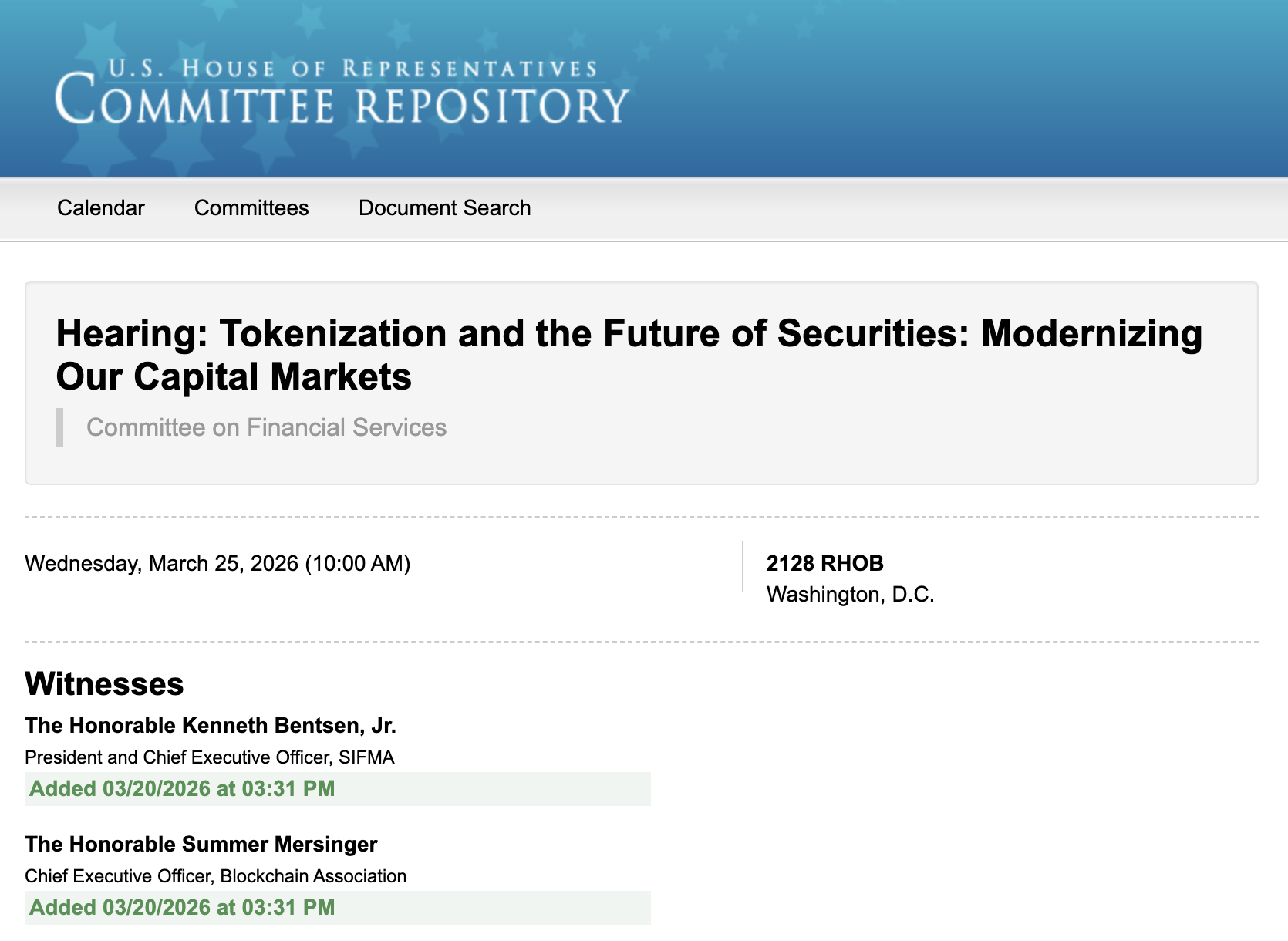
Lawmakers plan to focus on tokenized securities and derivatives under current law and possible new rules. One draft bill would require the SEC and CFTC to run a joint study on tokenized securities and derivatives. A second proposal would let certain regulated firms use blockchain-based records under future SEC rules for market recordkeeping.
Tokenization refers to recording ownership of stocks, bonds and other instruments on a blockchain rather than on traditional databases. Major market operators have been testing limited pilots in settlement and recordkeeping, including efforts tied to Nasdaq, the New York Stock Exchange and DTCC.
Supporters argue that moving records on-chain could speed up settlement, lower errors and cut costs while keeping investor protections in place. In January, the SEC stated that tokenized stocks and bonds remain subject to federal securities laws even when recorded on a blockchain. Earlier this month, the agency expanded its crypto framework by stating that most crypto assets are not securities, while keeping tokenized securities under its jurisdiction.
Two weeks ago, the SEC and CFTC entered a memorandum of understanding to coordinate rulemaking, supervision and enforcement in areas where their authorities overlap, including digital assets and market infrastructure. The agreement is intended to reduce gaps and duplication.
Austin Campbell, founder of the risk and compliance firm Zero Knowledge, called the hearing “one battle in a long war,” adding that it could move legislation forward and help staff understand how markets are changing. In his view, discussion will center on “what is going to be what is happening now, what is needed from a regulatory space for that to happen, and what will work going forward.”
Public affairs attorney Andrew Rossow described the witness slate as leaning toward incumbents and industry trade groups, pointing to the absence of a consumer or investor advocate, an academic skeptic, or a decentralized finance representative. He argued that the narrow focus leaves open a core legal question: how tokenized financial products are classified.
“Current legal precedent doesn’t cleanly answer this, and the Howey Test was not programmed or designed for instruments/assets that are both easily transferable and can also serve as securities and payment guardrails.”
Rossow warned that the draft allowing regulated firms to use blockchain-based records raises questions about which standards those records must meet, who must prove their reliability, and how failures such as blockchain reorganizations or lost private keys would be handled. He characterized a separate proposal to modernize markets through tokenization as a “delay mechanism dressed as action,” and pointed to investor risks tied to buggy code, unnoticed software upgrades and chain reorganizations.
Committee members are expected to ask how tokenized records would fit within rules for clearing, custody and investor protections, and what data and safeguards are needed before any wider rollout.
The content on The Coinomist is for informational purposes only and should not be interpreted as financial advice. While we strive to provide accurate and up-to-date information, we do not guarantee the accuracy, completeness, or reliability of any content. Neither we accept liability for any errors or omissions in the information provided or for any financial losses incurred as a result of relying on this information. Actions based on this content are at your own risk. Always do your own research and consult a professional. See our Terms, Privacy Policy, and Disclaimers for more details.
Articles by this author