SEC сlears Nasdaq tokenized trades for Russell 1000, ETFs
The SEC approved Nasdaq’s plan to trade tokenized Russell 1000 stocks and select ETFs, with DTC settlement and a fallback to traditional processing when tokenized settlement is unavailable.
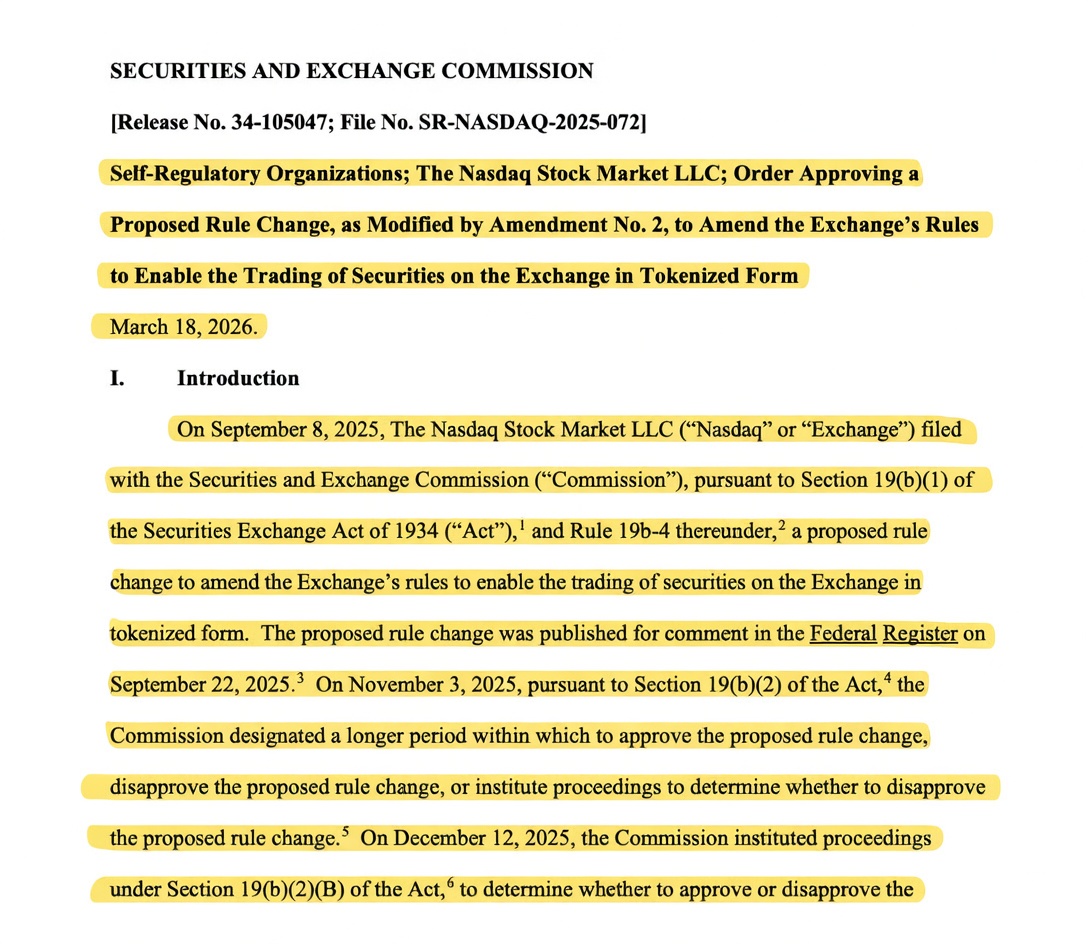
The U.S. Securities and Exchange Commission on Wednesday approved Nasdaq’s plan to enable tokenized trading for stocks in the Russell 1000 and certain index exchange-traded funds. Processing will run through the Depository Trust Company, with trades reverting to traditional settlement when tokenized settlement cannot be completed.
Under the approved structure, participating brokers can flag an order for tokenized settlement at entry. After execution, Nasdaq will transmit the instruction to DTC. If the broker or security is ineligible, or if the designated blockchain or wallet is incompatible, the transaction will settle through the standard process.
The program applies to securities already listed on a national securities exchange. Tokenized shares must match their conventional counterparts in rights, ticker symbols, and trading priority. In this context, tokenization means creating a digital record on a blockchain that is tied to an existing stock or ETF and carries the same investor rights.
Nasdaq’s approach keeps trading and settlement on existing market infrastructure rather than shifting to a separate on-chain venue. The framework is intended to fit within current regulatory requirements while letting market participants test blockchain-based post-trade functions without changing how orders are handled.
Nasdaq filed the proposal in September. During the review, industry groups raised questions about mechanics, market risks, and the role of issuers. The Securities Industry and Financial Markets Association and Cboe Global Markets sought clarity on DTC’s role. The Digital Chamber urged regulators to avoid favoring specific technologies and to give issuers more influence. Better Markets opposed the plan, citing concerns about potential price gaps, surveillance, and legal uncertainty.
The SEC’s approval confines activity to DTC-based processing with a defined fallback to standard settlement. Earlier this year, SEC staff reiterated that tokenized assets are treated as securities under federal law, regardless of the database or ledger technology used.
“It starts to make listed equities more programmable, not just more digital,” according to Steven Wu, chief operating officer at Clearpool. Wu also pointed to the industry’s shift from T+3 to T+1 and interest in T+0 and more continuous markets.
Institutional firms are focused on how tokenized instruments connect to the post-trade ecosystem. Samar Sen, head of international markets at Talos, highlighted review areas including integration with central clearing and settlement systems and whether liquidity develops consistently across both tokenized and traditional formats.
Separately, Nasdaq has announced a partnership with Payward, parent of Kraken, to develop tokenized equities aimed at modernizing corporate actions, shareholder engagement, and proxy voting, with a target launch in the first half of 2027. Nasdaq indicated that those tokenized shares would carry full legal and regulatory equivalence to traditional shares.
The content on The Coinomist is for informational purposes only and should not be interpreted as financial advice. While we strive to provide accurate and up-to-date information, we do not guarantee the accuracy, completeness, or reliability of any content. Neither we accept liability for any errors or omissions in the information provided or for any financial losses incurred as a result of relying on this information. Actions based on this content are at your own risk. Always do your own research and consult a professional. See our Terms, Privacy Policy, and Disclaimers for more details.
Articles by this author