BlockFills files Chapter 11 in Delaware amid crypto clump
Chicago’s BlockFills filed for Chapter 11 protection in Delaware, listing $50M–$100M in assets and $100M–$500M in liabilities after weeks of liquidity strain linked to the crypto selloff.
BlockFills, a Chicago-based crypto trading and lending platform, filed for Chapter 11 protection in the U.S. Bankruptcy Court for the District of Delaware, listing $50 million to $100 million in assets and $100 million to $500 million in liabilities after weeks of liquidity strain tied to the market selloff.
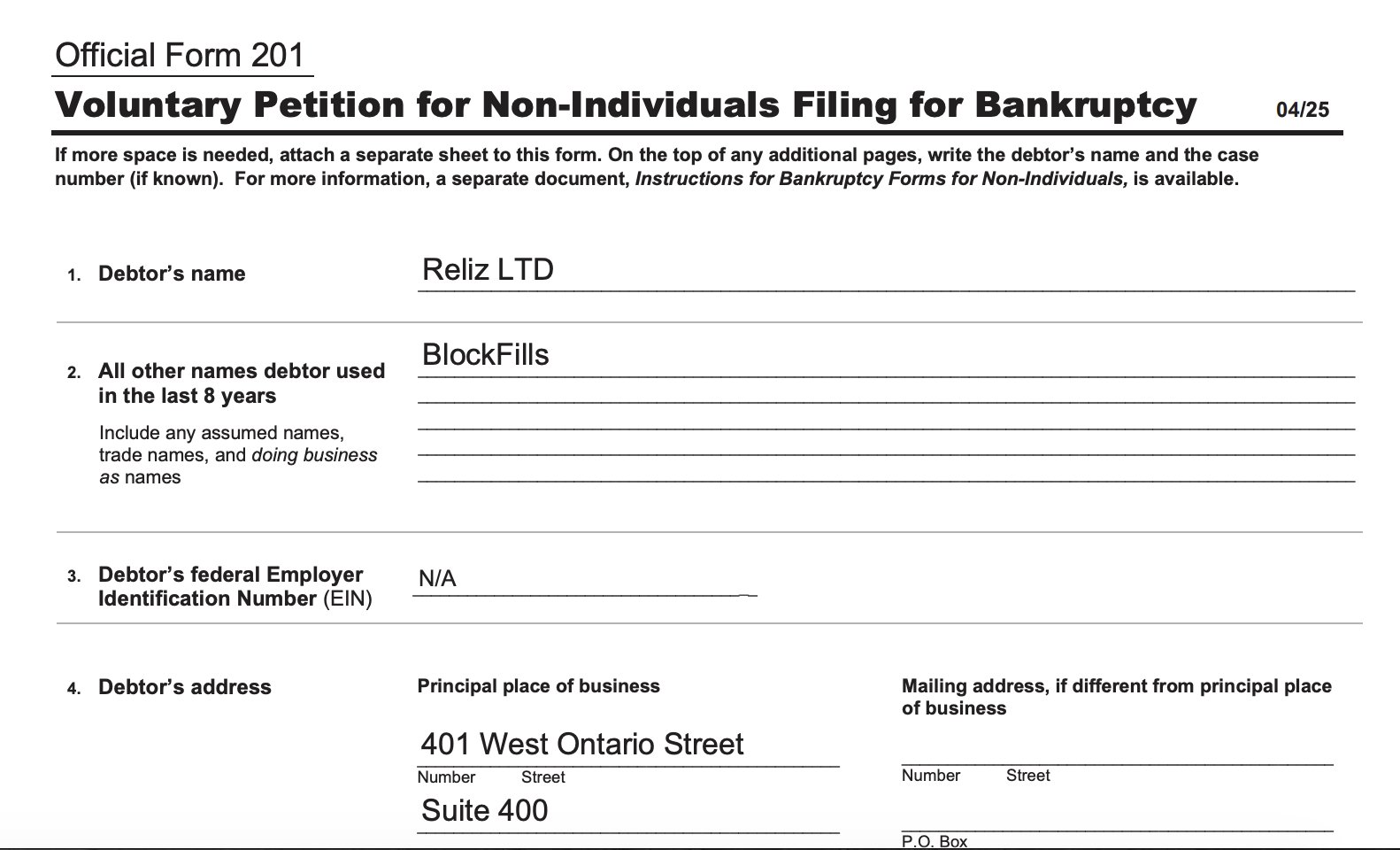
Court papers show Reliz Technology Group, BlockFills’ parent and operator, and affiliated entities are seeking joint protection while preparing a reorganization plan to address unsecured creditor claims. The board approved the petition on March 9 after consulting financial and legal advisers. The board’s written consent states: “The Board has had the opportunity to consult with the financial and legal advisors of the Company and to fully consider each of the strategic alternatives available to the Company.”
The filing lists unsecured claims that together exceed $50 million. 007 Capital LLC is owed $17.1 million. The Richard E. Ward Revocable Trust has a $9.4 million claim. Artha Investment Partners LLC and SBI VC Trade Co. Ltd. are owed $6.9 million and $6.3 million, respectively. Dorado Family Holdings LP has a $5.7 million claim, Nexo Capital Inc. holds a $4.7 million promissory note, and the Chicago Blackhawks appear with a disputed trade payable of about $1.3 million.
Reliz Technology Group reports more than 2,000 institutional clients, including professional traders, hedge funds, high-net-worth individuals, and large-scale Bitcoin miners. The platform handled about $60 billion in trading volume in 2025, according to the court record. Shareholders include CME Ventures with a 2% stake, K&H Crypto LLC with 17%, and Nexo Inc. with 2%.
Operational stress surfaced in February when BlockFills paused client deposits and withdrawals on February 11, citing extreme volatility. Trading in spot and derivatives stayed open so clients could manage positions during the pause. A company spokesperson described the suspension as intended to “further the protection of clients and the firm” from prevailing market conditions.
The bankruptcy arrives during a broader downturn that accelerated after a large liquidation event on October 10 last year. Market data show total crypto market capitalization has fallen to about $2.6 trillion from roughly $4.3 trillion in early October. That selloff was part of the same market shock examined in $400B wiped out in 4 hours, which traced how tariffs and cascading liquidations hit digital assets. Bitcoin is down about 41.5% from its record high of $126,080 to $73,742 at the time of the filing.
BlockFills joins digital asset firms that have pursued court protection during prior slumps. In 2022, Celsius Network, Voyager Digital, BlockFi, and Genesis filed for bankruptcy after market shocks reduced liquidity across the sector.
The Delaware case allows BlockFills and Reliz to propose a restructuring addressing creditor claims and the future of the trading and lending business. The initial petition did not include specifics on asset sales, new financing, or a timeline for resuming normal client fund flows.
The content on The Coinomist is for informational purposes only and should not be interpreted as financial advice. While we strive to provide accurate and up-to-date information, we do not guarantee the accuracy, completeness, or reliability of any content. Neither we accept liability for any errors or omissions in the information provided or for any financial losses incurred as a result of relying on this information. Actions based on this content are at your own risk. Always do your own research and consult a professional. See our Terms, Privacy Policy, and Disclaimers for more details.
Articles by this author