WTI retreats after false-alarm spike; $102.25 in focus

WTI crude jumped about 5% on an unverified post reporting explosions in Iran, then fell back; market participants are watching the $102.25 pivot and 20-day moving average.
On 23 April 2026 in the early Asian session, NYMEX WTI rose almost 5% within about 15 minutes after an unverified post reported explosion sounds across Iran, touching an intraday high of $97.22 at roughly 8:00 a.m. Singapore time. Prices later retraced most gains to about $94.27, up roughly 1.3% at the time of reporting.
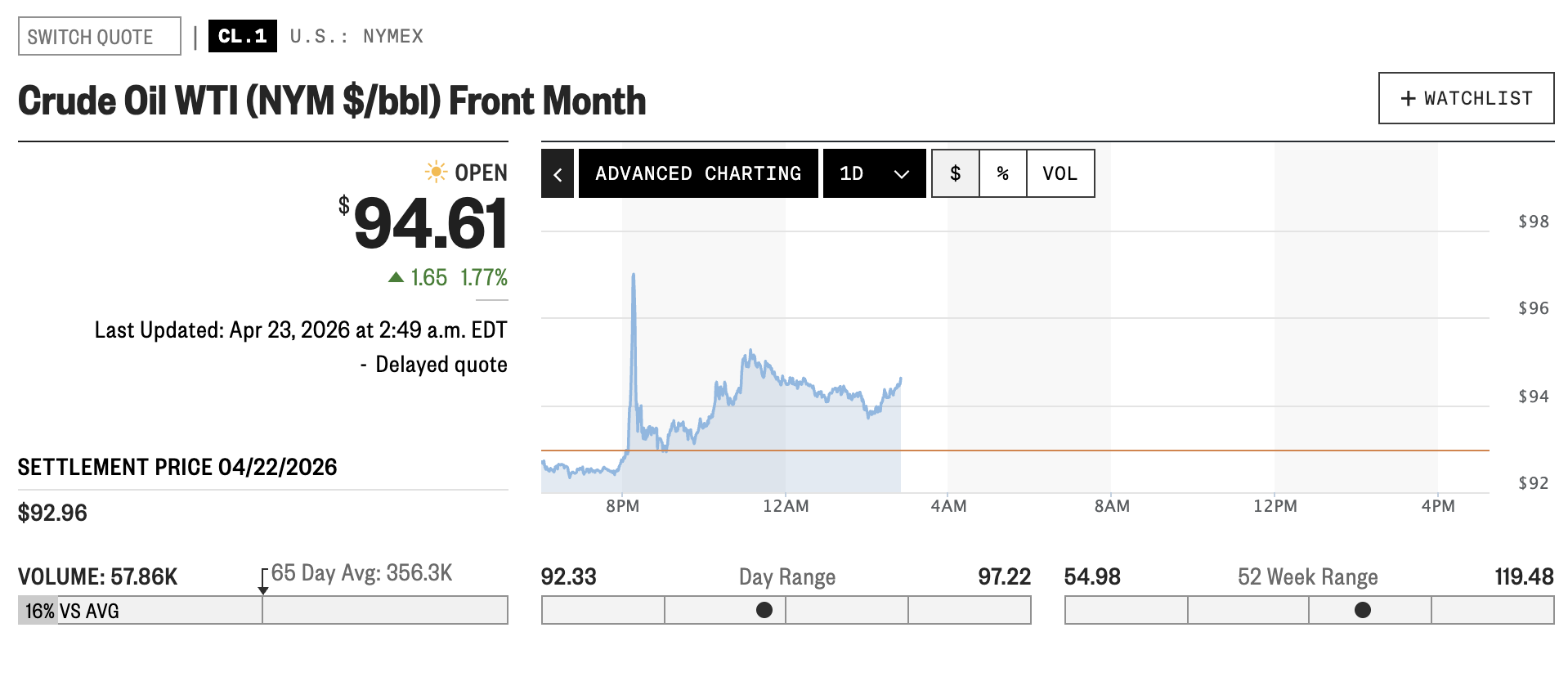
The initial report triggered moves in other markets: S&P 500 E-mini futures fell about 0.5%, Japan’s Nikkei 225 rose about 0.4%, Hong Kong’s Hang Seng fell about 1.1% and AUD/USD slipped roughly 0.2% during the session. Iranian authorities later described the sounds as part of an air-defense drill and said there had been no attack in Tehran.
Measures of volatility and futures structure have moderated since early April. The crude ETF volatility index (OVX), which reflects 30-day implied volatility, declined from near 98.79 on 7 April to about 76.77 on 22 April. The 12-month WTI calendar spread narrowed to -19.90 on 22 April from a peak backwardation of -41.57 recorded on 2 April.
On short-term charts, WTI moved up from a range support around $81.94–$86.50 to test resistance at roughly $96.44–$98.35, a zone that aligns with the 20-day moving average. An hourly relative strength index displayed a bearish divergence after prices entered overbought territory and then fell below that band.
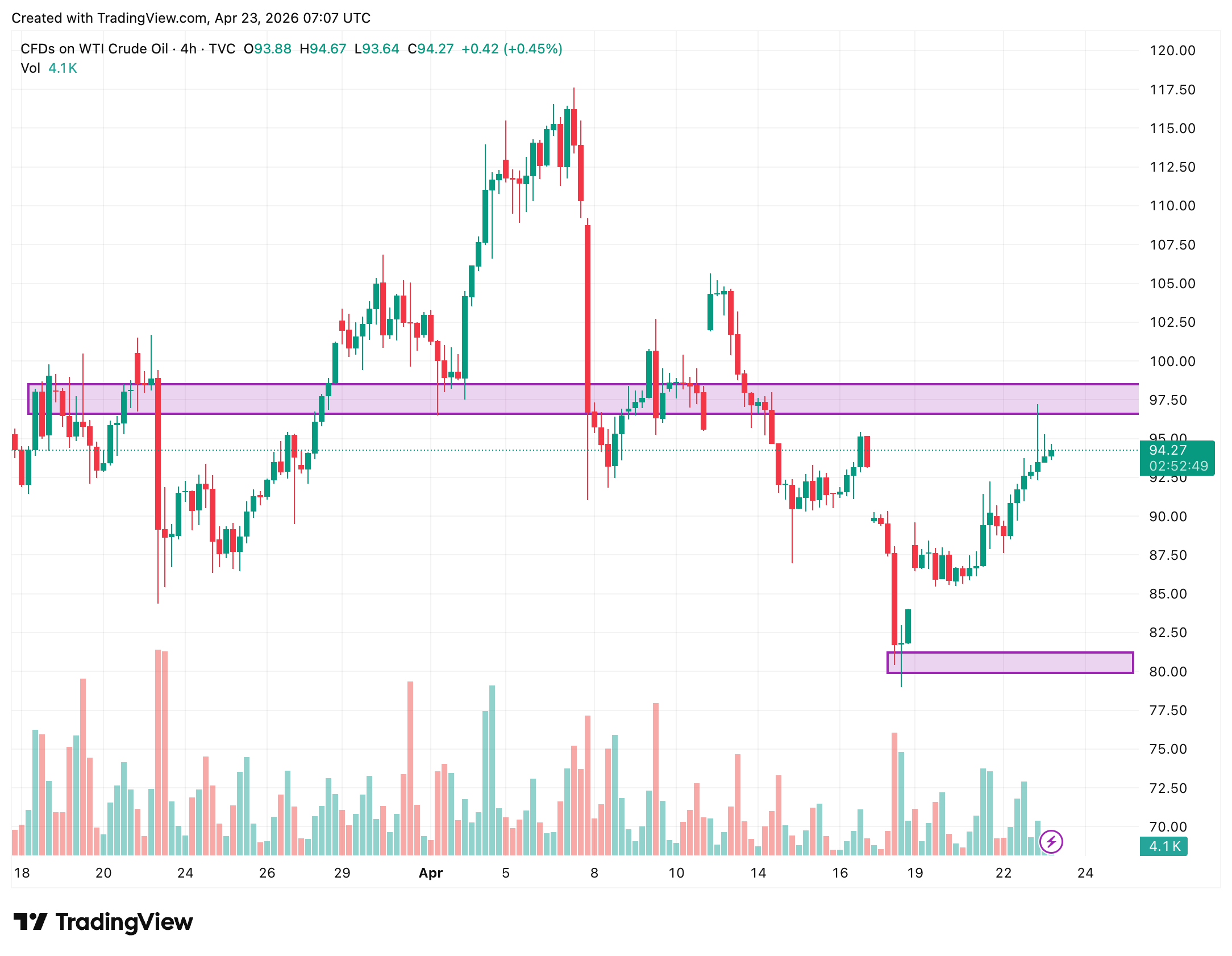
The advance from the 17 April low of $81.94 was about 22% and reached the 50% Fibonacci retracement of the prior decline from 7 April. Market participants are watching $102.25 as a short-term pivot. An hourly close above $102.25 places intermediate resistance levels at about $107.12 and $110.87 on technical charts. A drop below $90.50 would put the $81.94–$86.50 support range and the 50-day moving average back into focus.
Geopolitical developments remain part of the market backdrop. The United States extended an existing ceasefire with Iran to an indefinite period and said it was awaiting a new proposal from Tehran to resume talks, with U.S. officials describing the agreement as fragile. On 22 April, Iranian naval forces fired on commercial vessels in the Strait of Hormuz and U.S. forces intercepted two Iranian-flagged oil tankers.
Market participants noted that the intraday price spike followed an unverified report and was subsequently reclassified as a drill, after which crude prices retraced most of the early session gains.
The content on The Coinomist is for informational purposes only and should not be interpreted as financial advice. While we strive to provide accurate and up-to-date information, we do not guarantee the accuracy, completeness, or reliability of any content. Neither we accept liability for any errors or omissions in the information provided or for any financial losses incurred as a result of relying on this information. Actions based on this content are at your own risk. Always do your own research and consult a professional. See our Terms, Privacy Policy, and Disclaimers for more details.
Articles by this author