US futures dip as Trump rejects Iran reply; jobs lift yields
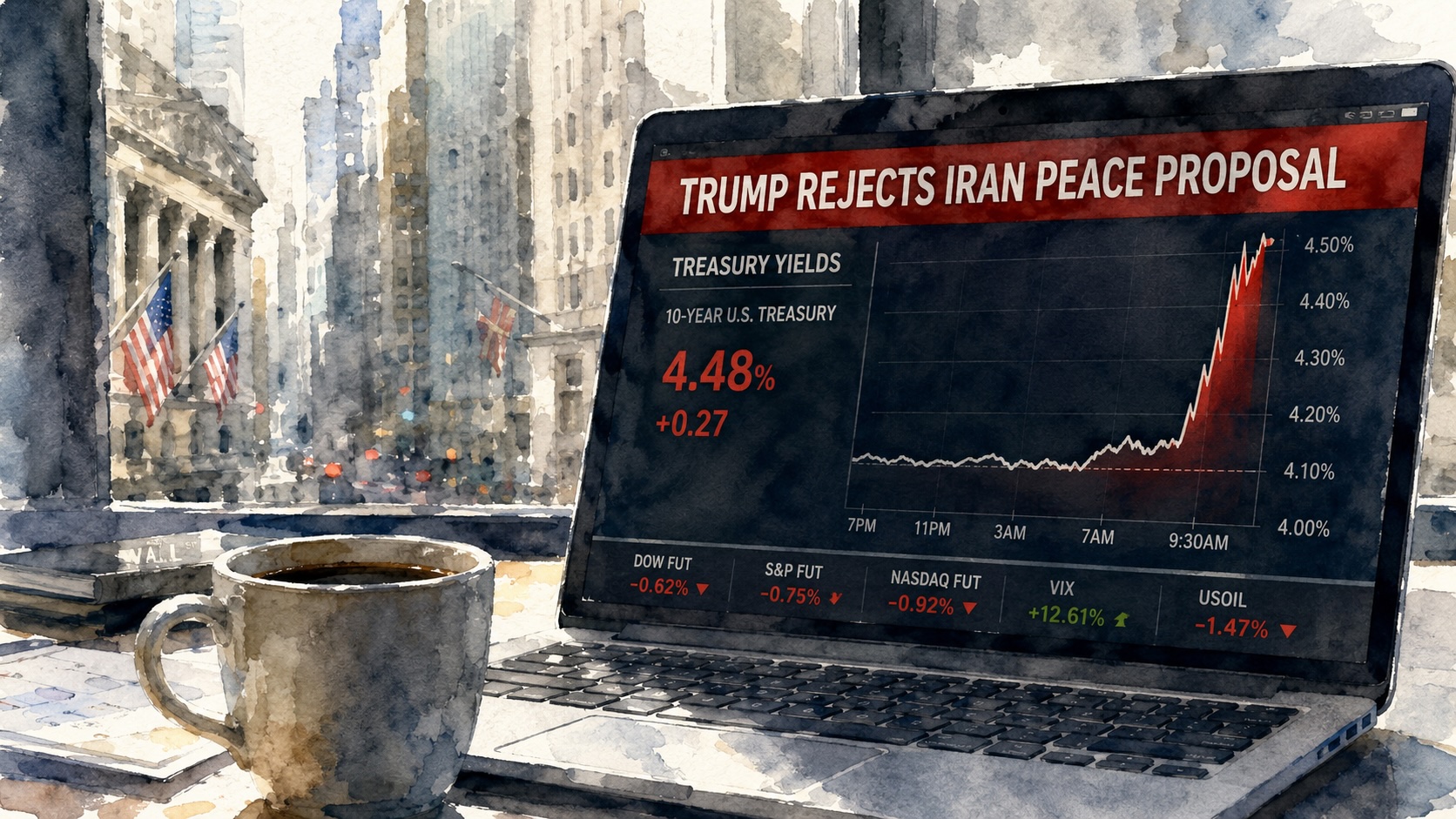
U.S. futures dipped after President Trump called Iran’s reply to a U.S. peace proposal ‘unacceptable’ and April payrolls rose 115,000, lifting Treasury yields and lowering odds of Fed cuts in 2026.
U.S. futures opened lower in early Asian trading after President Donald Trump called Iran’s reply to a U.S. peace proposal “unacceptable.” S&P 500 and Nasdaq 100 E‑mini futures each slipped about 0.2%.
The April jobs report showed nonfarm payrolls (NFP) rose by 115,000, above a consensus near 62,000. Stronger hiring pushed Treasury yields higher; the 30‑year U.S. Treasury yield traded near 4.90%, close to its 50‑day moving average. Market pricing for Federal Reserve rate cuts in 2026 declined.
| Release date | Time | Actual | Forecast | Previous |
| May 08, 2026 (Apr) | 13:30 | 115.00K | 65.00K | 185.00K |
| Apr 03, 2026 (Mar) | 13:30 | 178.00K | 65.00K | -133.00K |
| Mar 06, 2026 (Feb) | 13:30 | -92.00K | 58.00K | 126.00K |
| Feb 11, 2026 (Jan) | 13:30 | 130.00K | 66.00K | 48.00K |
| Jan 09, 2026 (Dec) | 13:30 | 50.00K | 66.00K | 56.00K |
| Dec 16, 2025 (Nov) | 13:30 | 64.00K | 51.00K | -105.00K |
Trump’s public rejection reduced the immediate prospects for a formal agreement with Iran after a late‑week exchange of fire that left a ceasefire intact. Energy and defense assets traded with a risk premium.
Equities retained AI-driven momentum, led by semiconductor stocks. Chipmakers including AMD and Micron contributed to recent gains. Apple has a preliminary arrangement with Intel to produce chips, and Jeff Bezos is raising $10 billion to support industrial AI model development.
Regional markets were mixed. China’s yuan reached a three‑year high against the dollar ahead of a summit between President Trump and President Xi on May 14–15. Japan’s yen showed volatility following suspected currency intervention. In early Asian trading, South Korea’s KOSPI rose about 4%, Japan’s Nikkei 225 gained roughly 0.5%, while the Hang Seng fell about 0.9% and the ASX 200 slipped about 0.8%.
Oil traded around $100 a barrel. Gold remained below its 50‑day moving average while central banks continued to add to reserves; China’s central bank purchased bullion for an 18th consecutive month.
Technical indicators on the Nasdaq 100 showed short‑term resistance near 29,505–29,615. A drop below 28,835 could expose support near 28,460–28,280; an hourly close above 29,615 would preserve the near‑term upside.
Upcoming data that could move markets include China’s April consumer and producer price numbers and U.S. existing home sales, along with any further diplomatic developments on the U.S. peace proposal with Iran.
The content on The Coinomist is for informational purposes only and should not be interpreted as financial advice. While we strive to provide accurate and up-to-date information, we do not guarantee the accuracy, completeness, or reliability of any content. Neither we accept liability for any errors or omissions in the information provided or for any financial losses incurred as a result of relying on this information. Actions based on this content are at your own risk. Always do your own research and consult a professional. See our Terms, Privacy Policy, and Disclaimers for more details.
Articles by this author