Mantle proposes 30,000 ETH loan to Aave DAO

Mantle proposed a secured loan of up to 30,000 ETH to Aave DAO to cover rsETH bad debt from the $292 million Kelp DAO exploit, repayable with interest up to 36 months.
The Mantle Core Contributor Team published proposal MIP-34 to authorize the Mantle Treasury to lend up to 30,000 ETH to Aave DAO. The funds would be supplied as a secured credit facility and used only to address rsETH-related shortfalls on Aave V3. The proposal says the loan principal would be repaid with interest.
The document sets an indicative interest rate equal to Lido’s staking APR plus a 1% premium, a maximum maturity of 36 months, and no penalty for early repayment. Mantle would secure the loan through a multisignature wallet and hold a first-priority lien and security interest over that wallet. Aave would be required to route 5% of its revenue to the wallet and post AAVE tokens worth at least $11 million as additional collateral. The proposal specifies the loan would become immediately due and payable in the event of default.
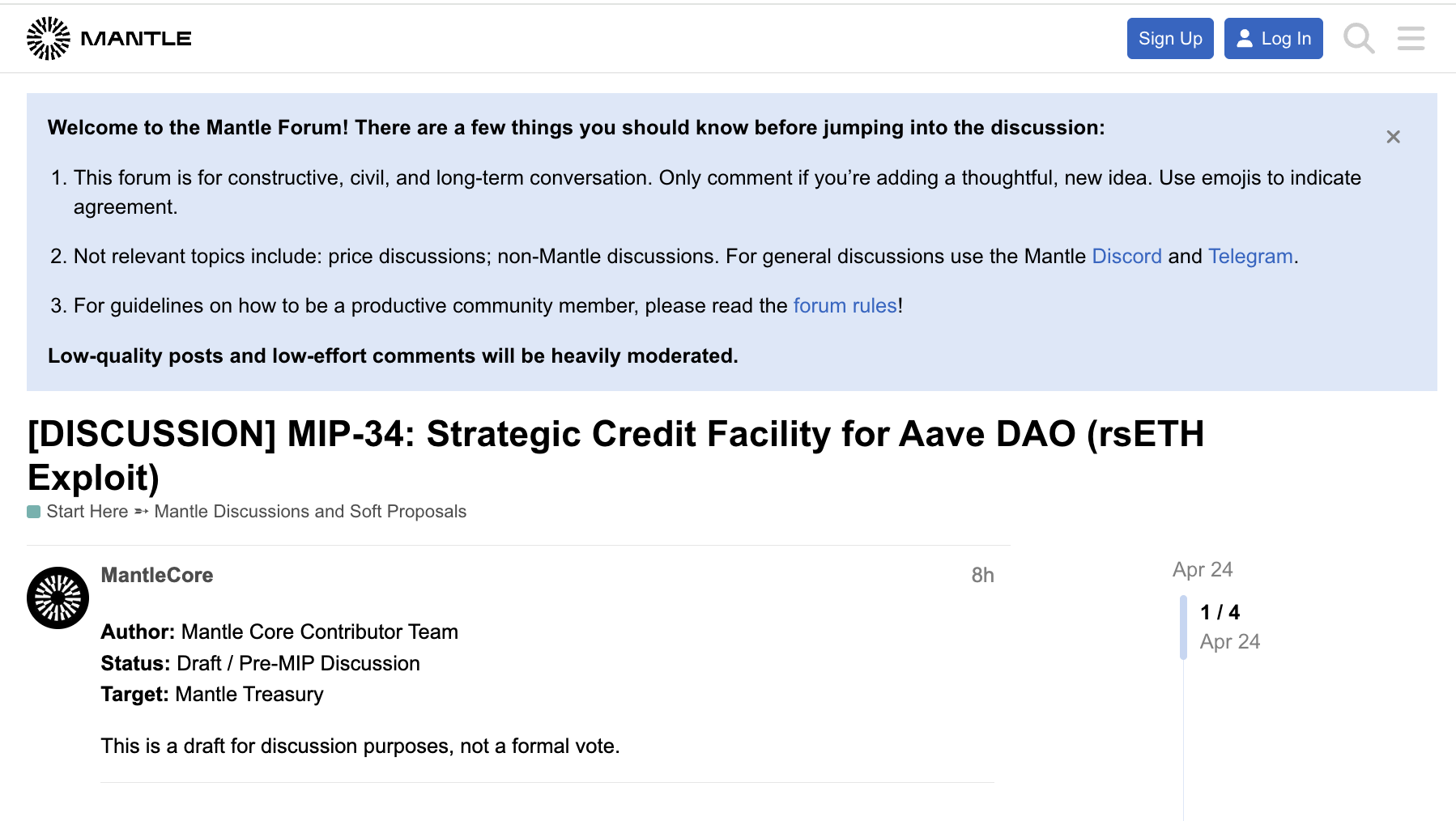
Mantle said interest proceeds would either be used to burn MNT tokens or to fund its ecosystem. The proposal frames the facility as a way to convert idle treasury holdings into a yield-generating credit asset while supporting Aave’s recovery and potential deployment on the Mantle Network.
Bybit, a strategic partner of Mantle, indicated support for the plan. Bybit CEO Ben Zhou wrote that when Bybit was hacked the industry rallied to help and urged similar cooperation for Aave:
“When we got hacked, the industry got together and helped us. It is the only right thing that we do the same to unite together and walk out from difficult times.”
The offer follows an April 18 security breach at Kelp DAO that led to the unauthorized minting of 116,500 rsETH, valued at about $292 million. Technical analysis of the incident indicates the attacker likely tampered with two RPC nodes and used a denial-of-service tactic to trick a cross-chain verification mechanism into signing a fraudulent transaction. The exploiter then supplied roughly $221 million of stolen rsETH as collateral on Aave V3 and borrowed about 82,650 WETH and 821 wstETH, creating large uncollateralized positions.
Aave’s internal incident review outlined scenarios that would leave the protocol with about $124 million or about $230 million in outstanding bad debt, depending on market actions and recovery efforts. On-chain tracking showed the attacker swapped roughly $175 million worth of stolen ETH into Bitcoin through THORChain and other services.
Other participants in the sector have taken steps to limit losses. The Arbitrum Security Council froze 30,766 ETH tied to an address linked to the exploiter. Lido Labs proposed allocating up to 2,500 staked ETH to reduce the rsETH shortfall. Several groups joined a coordinated relief effort called DeFi United: the EtherFi Foundation and Aave founder Stani Kulechov each pledged 5,000 ETH, the Golem Foundation pledged 1,000 ETH, and Frax Finance said it is preparing a contribution.
The Mantle loan proposal is subject to both Aave DAO and Mantle governance processes. Final terms, including the exact interest rate and security arrangements, remain to be negotiated.
The content on The Coinomist is for informational purposes only and should not be interpreted as financial advice. While we strive to provide accurate and up-to-date information, we do not guarantee the accuracy, completeness, or reliability of any content. Neither we accept liability for any errors or omissions in the information provided or for any financial losses incurred as a result of relying on this information. Actions based on this content are at your own risk. Always do your own research and consult a professional. See our Terms, Privacy Policy, and Disclaimers for more details.
Articles by this author