FBI: U.S. crypto fraud hit $11.3B in 2025; Seniors lost most

U.S. consumers reported $11.366 billion lost to crypto fraud in 2025, up 22% from 2024, the FBI found. Adults 60+ lost $4.432 billion, nearly 40% of the total.
U.S. consumers reported a record $11.366 billion lost to crypto-related fraud in 2025, a 22% rise from 2024, according to the FBI. Adults 60 and older accounted for $4.432 billion, nearly 40% of the total.
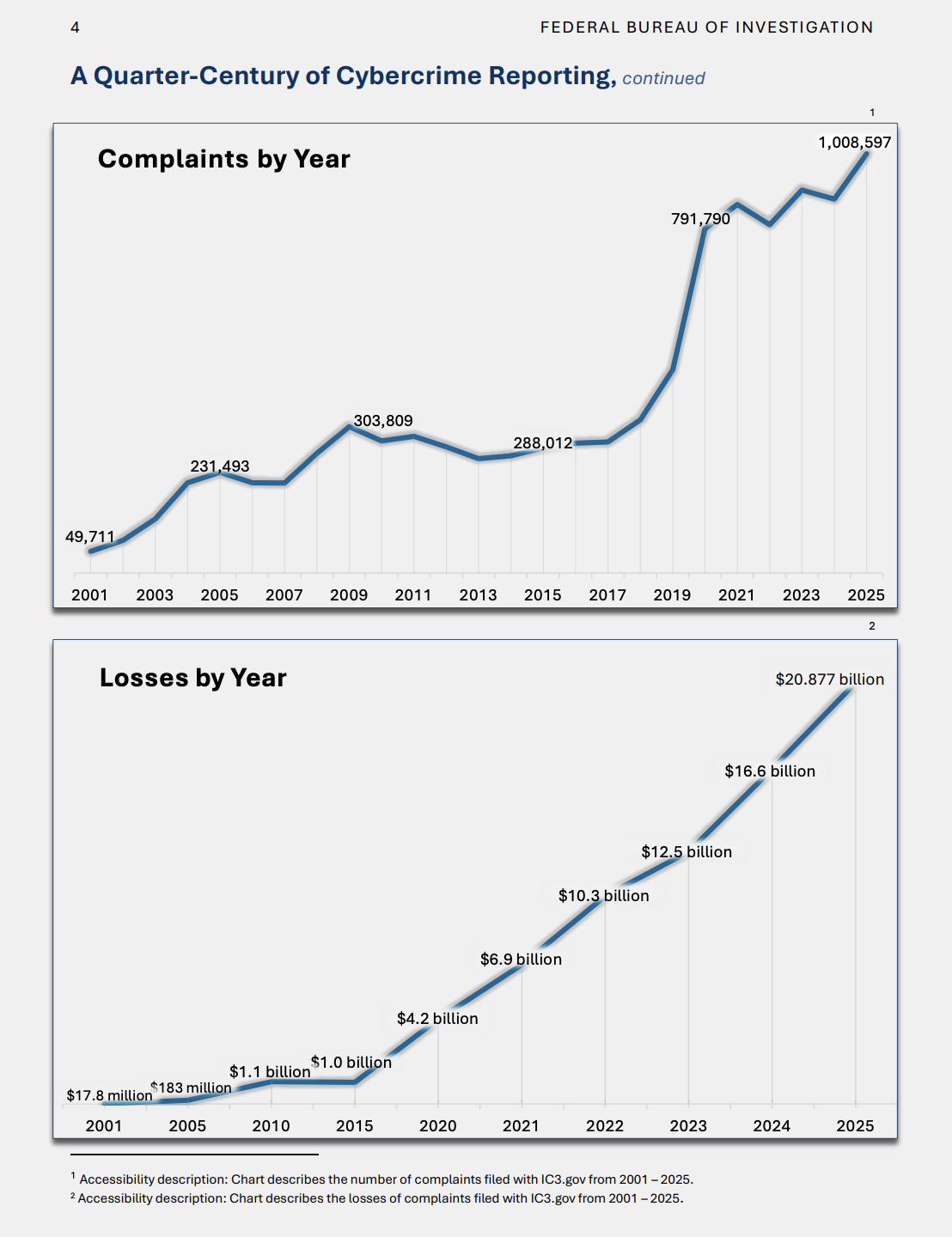
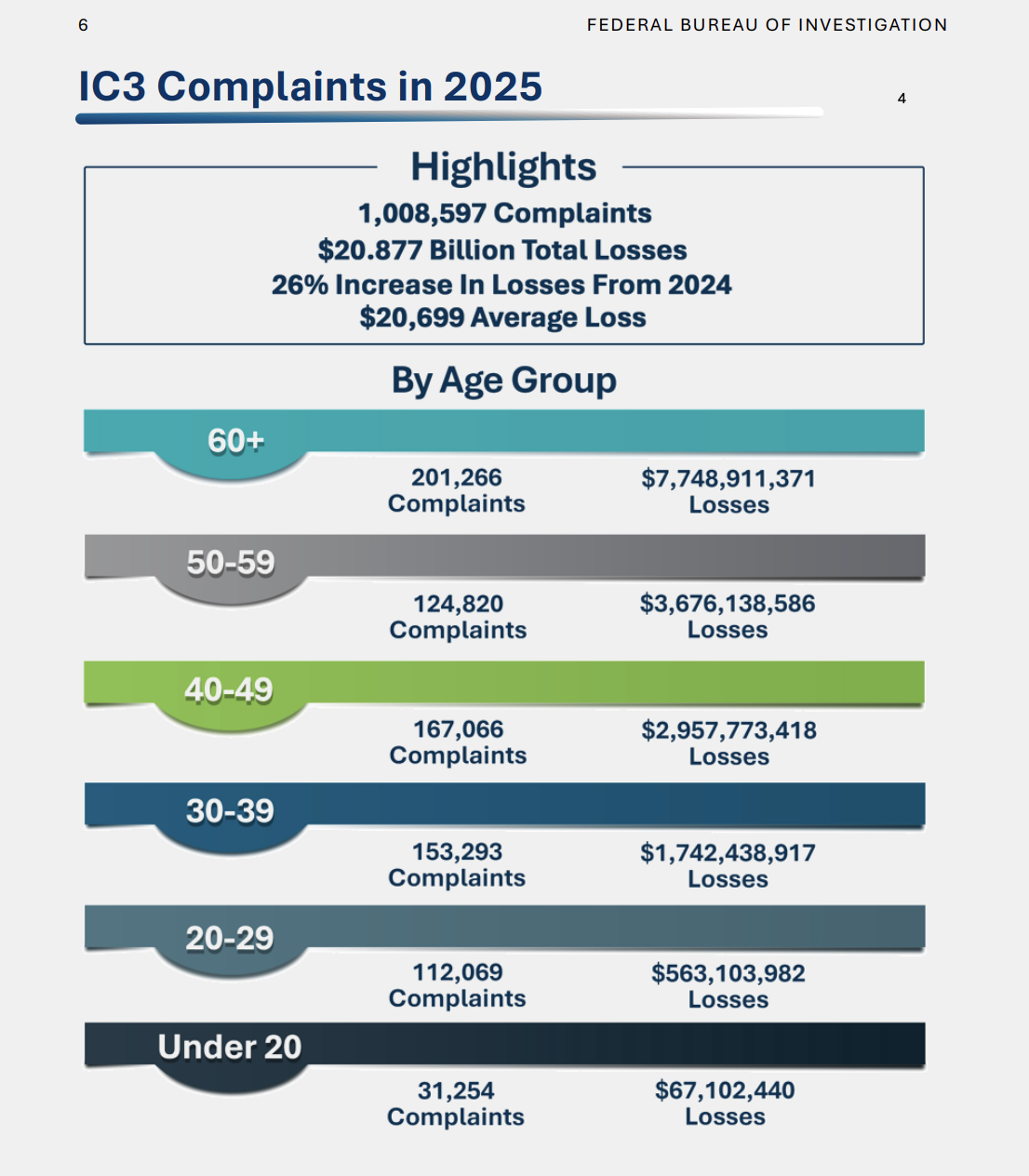
The figures come from the FBI's Internet Crime Complaint Center 2025 Internet Crime Report, released Monday. The report logged 181,565 crypto-related complaints last year, up 21% year over year. IC3 received more than 1 million complaints overall, and cyber-related crimes across categories cost Americans nearly $21 billion. About 45% of complaints involved cyber-enabled fraud or scams, which represented 85% of reported losses.
In crypto cases, the average reported loss was $62,604, and 18,589 victims reported losing more than $100,000. Crypto investment scams led all categories with $7.228 billion in losses, a 25% increase from 2024, while complaints in that category rose 48%. Across fraud types, AI-linked complaints topped 22,000, with adjusted losses above $893 million.
Older Americans experienced the heaviest impact. People 60 and over filed 44,555 crypto-related complaints and lost $4.432 billion in 2025, nearly double the $2.139 billion reported by victims in their 50s and up sharply from the $2.8 billion seniors lost in 2024. The group makes up about 17% of the U.S. population.
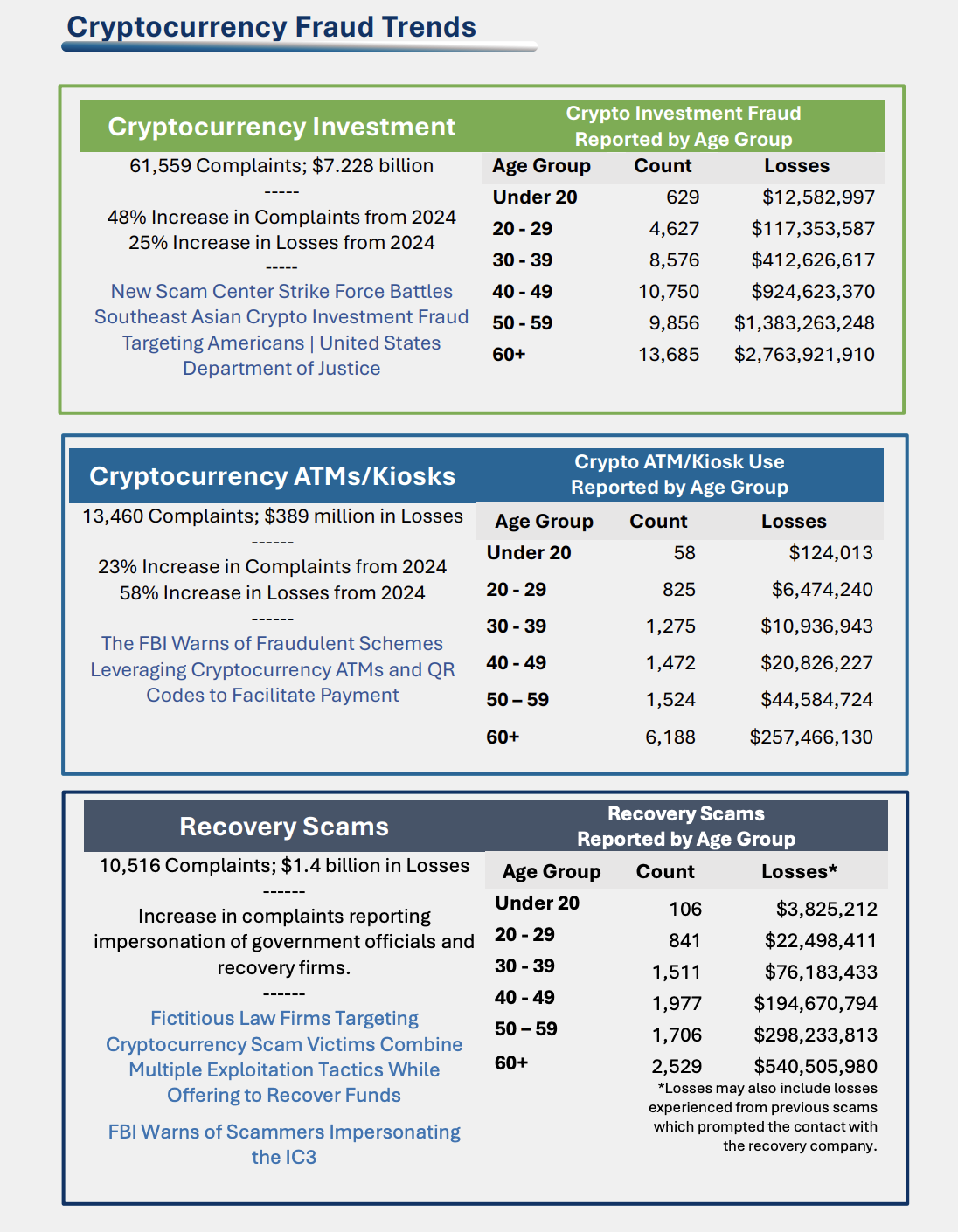
Fraud involving crypto ATMs and kiosks accelerated. IC3 recorded 13,460 ATM-related complaints in 2025 that produced $389 million in losses, a 58% jump in losses and a 23% rise in complaints from 2024. Seniors accounted for $257.4 million of those ATM losses across 6,188 complaints. Scammers often direct victims to scan QR codes or deposit cash at kiosks, funneling money into cryptocurrency wallets that are difficult to trace and recover.
Recovery schemes added further damage. Fraudsters posing as investigators, customer support, or law firms that claim they can retrieve stolen funds accounted for another $1.4 billion in crypto losses, frequently targeting people who had already been victimized.
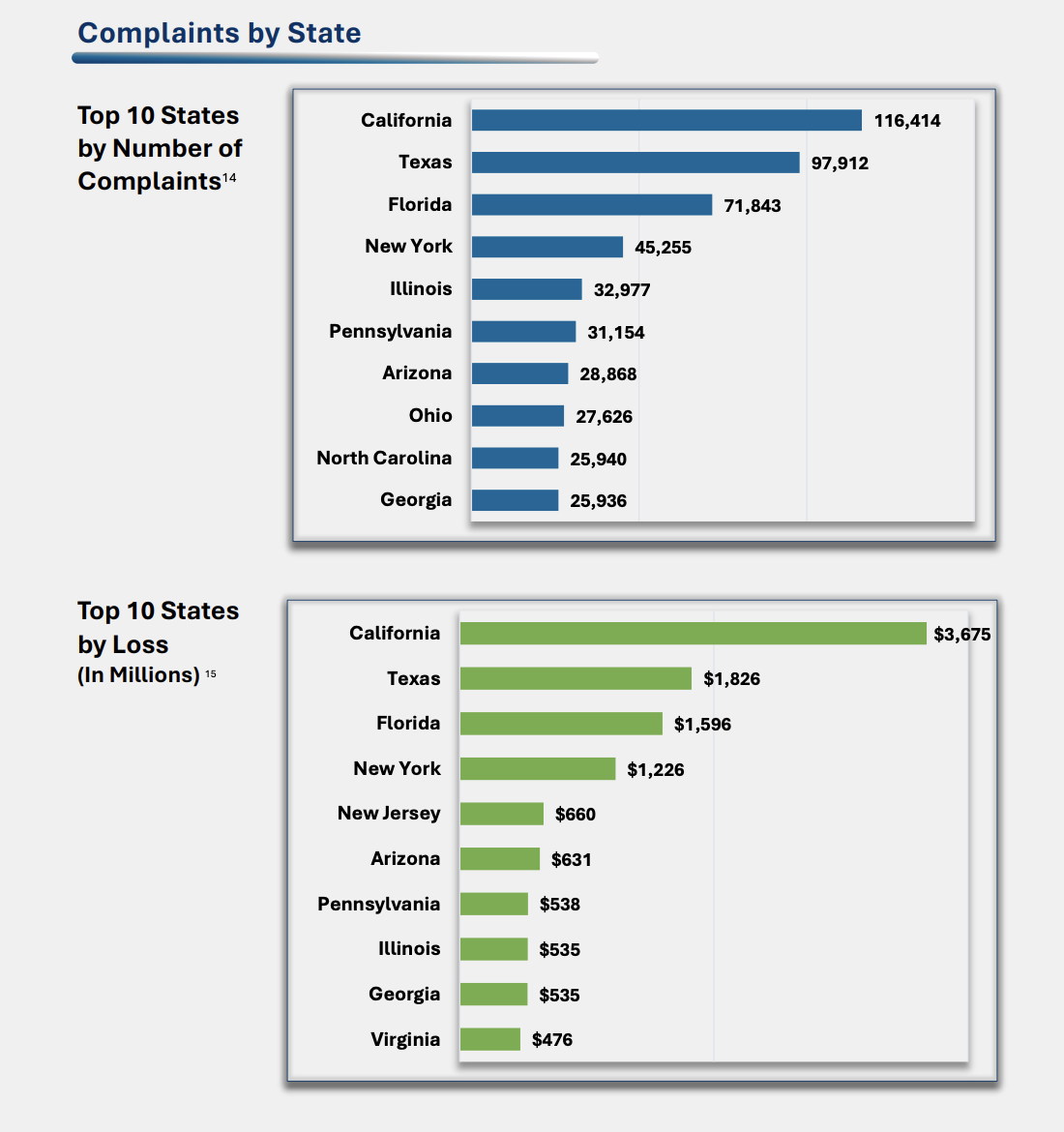
Losses were concentrated in several states. California led with $2.099 billion reported, followed by Texas at $1.016 billion, Florida at $914.5 million, New York at $593.4 million, and Oregon at $545.9 million, despite Oregon ranking 24th in complaint volume.
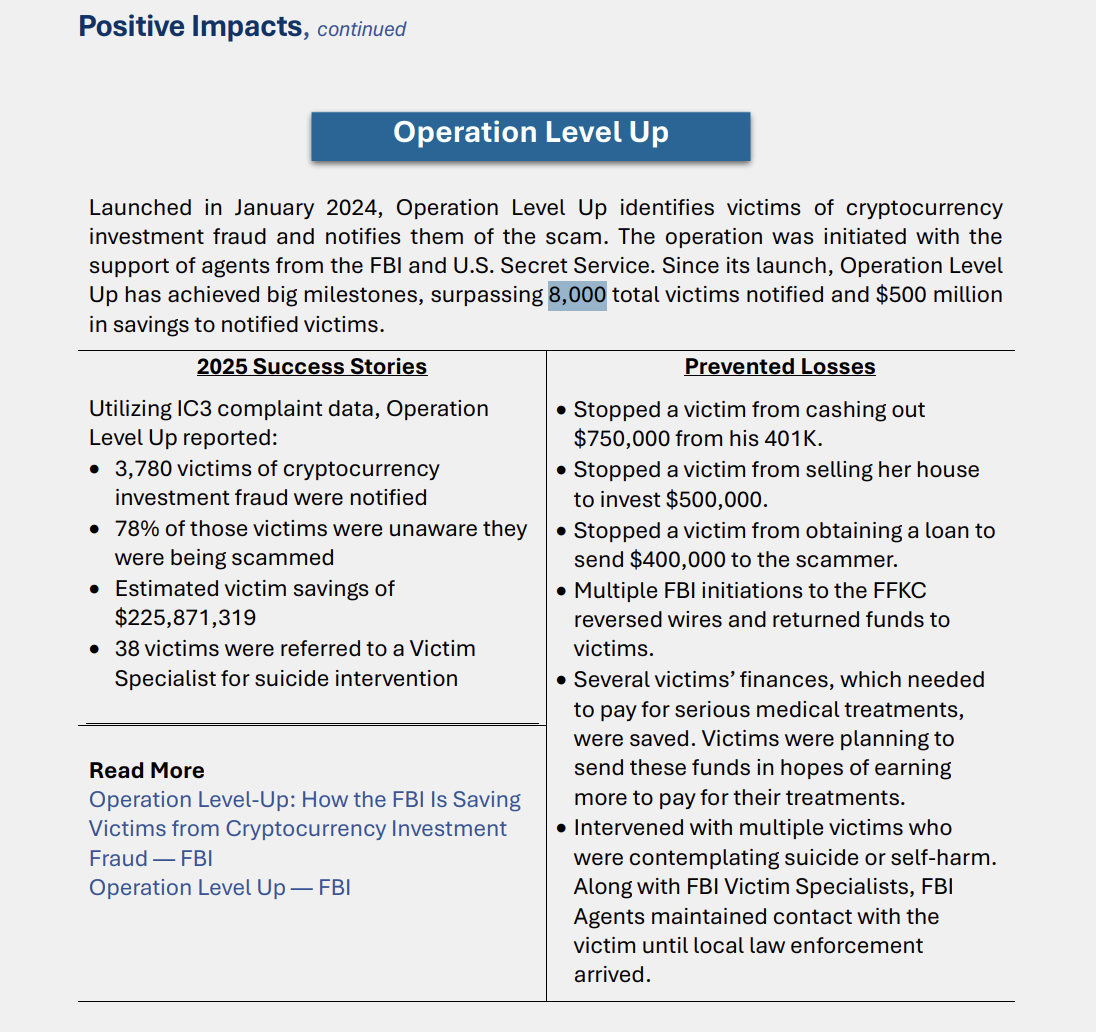
The FBI pointed to prevention and disruption efforts. Through Operation Level Up, which targets crypto investment scams, the Bureau has notified more than 8,000 potential victims and helped prevent over $500 million in losses to date, including $225.9 million in 2025. “The FBI remains fully committed to ensuring Americans' safety online,” noted Jose Perez, operations director for the Bureau's Criminal and Cyber Branch. The report referenced a recent executive order focused on cybercrime and fraud.
Policy responses gained momentum at the state level. West Virginia enacted a law that brings crypto kiosks under money transmission licensing rules. Minnesota lawmakers are considering an outright ban on the machines. In Connecticut, regulators suspended Bitcoin Depot's operating license after finding the company overcharged users and did not fully refund fraud victims; the company's CEO later resigned.
Industry figures described the headline totals as incomplete. “The FBI's $11.3 billion number is an important benchmark that tracks growth, but captures only part of the picture,” according to Ari Redbord, global head of policy at TRM Labs. Redbord estimates global fraud losses near $35 billion, with only about 15% of victims reporting. He views the United States as an attractive victim base due to high digital asset adoption and liquidity.
Tactics are shifting as controls tighten on high-risk payment channels, according to Stefan Muehlbauer, head of U.S. government affairs at security firm CertiK. “By the time a victim is at a kiosk, they are already deep in the scammer's trance,” he noted. Muehlbauer urged a defense-in-depth approach that combines AI-driven detection, stronger recovery systems, and public education, and cautioned that restrictions on crypto ATMs are pushing criminals toward more sophisticated social engineering, including deepfakes. Both Redbord and Muehlbauer expect fraud volumes to keep growing even as enforcement and compliance improve.
The content on The Coinomist is for informational purposes only and should not be interpreted as financial advice. While we strive to provide accurate and up-to-date information, we do not guarantee the accuracy, completeness, or reliability of any content. Neither we accept liability for any errors or omissions in the information provided or for any financial losses incurred as a result of relying on this information. Actions based on this content are at your own risk. Always do your own research and consult a professional. See our Terms, Privacy Policy, and Disclaimers for more details.
Articles by this author