JPMorgan CEO Jamie Dimon criticizes remote work; Experts back hybrid

At a Washington, D.C., forum, JPMorgan CEO Jamie Dimon argued remote work fails many younger staff; researchers contend hybrid schedules address training needs and allow quiet time for focused work.
At the Hill and Valley Forum in Washington, D.C., on Tuesday, JPMorgan Chase CEO Jamie Dimon criticized remote work, arguing it does not work for many younger employees who need in-person coaching. Workplace researchers pointed to hybrid schedules as a way to address those concerns.
Dimon framed early-career development as something that happens in direct contact with more experienced colleagues:
“They learn by going on a sales call with you. They learn by seeing you make a mistake. They learn by how you deal with the mistake.”
In his view, working in the same room helps build judgment and emotional intelligence, while video calls make team management looser and easier to game. He mocked the lack of focus on Zoom, suggesting people are often distracted and messaging each other instead of paying attention. Face-to-face meetings, by contrast, leave much less room to check out.
He also argued that companies should prioritize customers over employee comfort. To illustrate the point, he turned to a restaurant analogy, asking how diners would react if the business focused on staff happiness rather than serving “your well-cooked steak or your martini on time.”
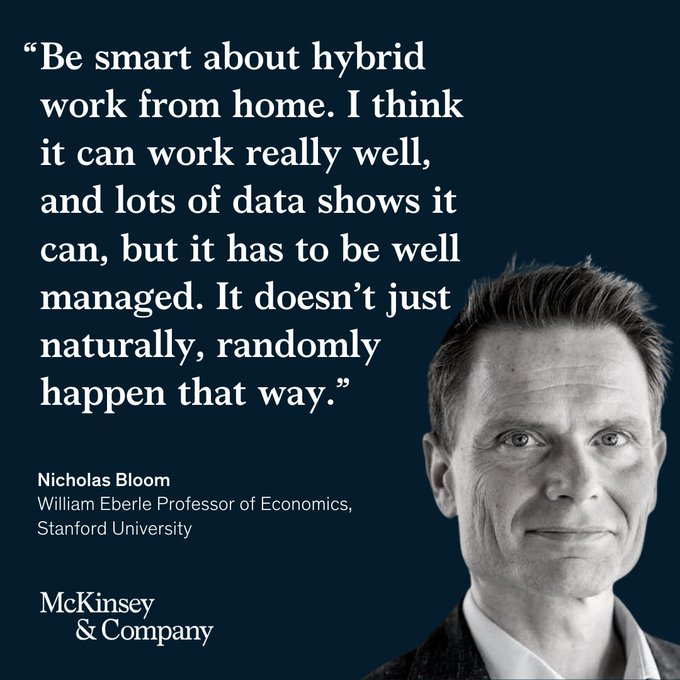
Stanford economist Nicholas Bloom took a narrower view than Dimon. He agreed that junior staff in apprenticeship-heavy roles benefit from regular time in the office and suggested three to four days a week as a reasonable baseline. Beyond a handful of fields such as trading, though, he did not see a strong case for a full five-day return.
For more experienced employees, Bloom argued that some work is simply better done away from the office. Reading, thinking, writing reviews, preparing presentations, and drafting client pitches often require uninterrupted time, which he said people usually get more easily at home. His broader point was that critics often attack fully remote work while ignoring hybrid arrangements, which he described as highly effective. To make the case, he used a simple analogy: the problem is not moderation, but excess.
Ravi Gajendran, a leadership and management professor at Florida International University, viewed some of Dimon’s concerns as “perhaps less relevant in a hybrid world.” He pointed to research indicating “the benefits of flexibility outweigh the costs of isolation for key outcomes such as job satisfaction, commitment, performance, and turnover intentions.” In his words, “If remote work makes employees more satisfied, committed, and productive, that should ultimately benefit customers.”
Dimon has pressed for in-office work for years. In his 2021 shareholder letter, he wrote that remote setups reduce spontaneous learning and creativity because people do not “run into people at the coffee machine, talk with clients in unplanned scenarios, or travel to meet with customers and employees for feedback on your products and services.” In 2025, he directed a firm-wide return to the office for most staff at JPMorgan, the largest U.S. bank by assets. In a leaked audio recording from early 2025, he complained, “I call a lot of people on Fridays, and there's not a goddamn person you can get a hold of.”
Other executives have raised similar points. Former Google CEO Eric Schmidt reflected that he learned early in his career by listening to older coworkers argue in person and questioned how to recreate that dynamic remotely.
Elon Musk of Tesla and SpaceX has argued it is unfair for “laptop classes” to work from home while others build cars, deliver food, and repair homes, saying outspoken remote-work advocates give “Marie Antoinette vibes.”
The debate now often centers on how many office days are needed and for whom. Dimon maintains that younger bankers gain the most from time with managers and clients, while researchers promote hybrid schedules that combine in-person collaboration with at least one day of quiet work at home.
The content on The Coinomist is for informational purposes only and should not be interpreted as financial advice. While we strive to provide accurate and up-to-date information, we do not guarantee the accuracy, completeness, or reliability of any content. Neither we accept liability for any errors or omissions in the information provided or for any financial losses incurred as a result of relying on this information. Actions based on this content are at your own risk. Always do your own research and consult a professional. See our Terms, Privacy Policy, and Disclaimers for more details.
Articles by this author