Grayscale: Bitcoin’s quantum risk Is social, not technical

After a March 30 Google paper on quantum threats, Grayscale strategist Zach Pandl argued the primary Bitcoin risk is social, focusing on the management of 1.7M BTC in early addresses while calling for post-quantum defenses.
Following a March 30 paper from Google researchers, Grayscale’s head of research, Zach Pandl, argued Bitcoin’s quantum exposure is primarily a governance issue, not a coding flaw. He urged the community to decide how to treat roughly 1.7 million BTC in early addresses that could be more exposed to future quantum attacks.
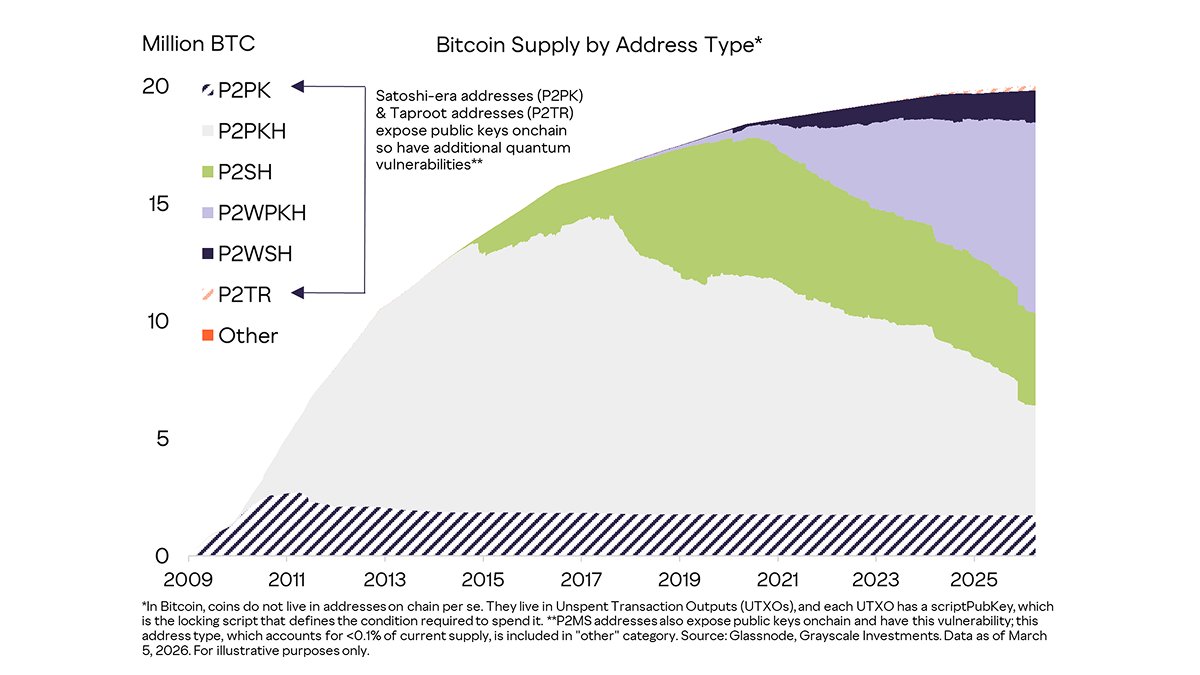
The Google paper outlined more efficient methods a quantum computer could use against current cryptography. Pandl countered that Bitcoin’s design-its unspent transaction output model, Proof-of-Work consensus and lack of native smart contracts-limits technical risk compared with networks that rely heavily on complex smart contracts. He also noted that some address types are not vulnerable in the same way.
According to Grayscale’s analysis, about 1.7 million BTC reside in early pay-to-public-key addresses, a format that could be easier to target if powerful quantum machines emerge. That pool includes an estimated 1 million BTC linked to Satoshi Nakamoto’s mining-era holdings, worth about $68 billion at recent prices. Pandl framed three paths under discussion: remove those coins from circulation, slow any spending from vulnerable addresses, or leave the system unchanged. “All are conceptually doable, but the challenge is reaching a decision,” he wrote.
Reaching consensus has been difficult on past protocol debates. Pandl pointed to the 2023 fight over storing image data on Bitcoin through inscriptions, which showed how hard broad agreement can be even when the technical approach is clear.
There is no immediate threat from quantum computers to public blockchains today, Pandl emphasized, but he urged preparation. He called for faster development and testing of post-quantum cryptography-signature schemes designed to withstand attacks from quantum hardware. Work is already underway in several ecosystems, including experiments on Solana and the XRP Ledger, and a roadmap published by the Ethereum Foundation in February.
The timing for deploying quantum-resistant signatures remains uncertain, and any change for Bitcoin would require agreement among developers, miners, businesses and users. For now, Pandl’s message was to begin the work, keep the network stable and avoid alarm. “In our view, there is no security threat to public blockchains from quantum computers today,” he wrote, adding that investors “should not fret” while development continues.
The content on The Coinomist is for informational purposes only and should not be interpreted as financial advice. While we strive to provide accurate and up-to-date information, we do not guarantee the accuracy, completeness, or reliability of any content. Neither we accept liability for any errors or omissions in the information provided or for any financial losses incurred as a result of relying on this information. Actions based on this content are at your own risk. Always do your own research and consult a professional. See our Terms, Privacy Policy, and Disclaimers for more details.
Articles by this author