ECB lays out digital euro plan, with banks at the core

ECB board members set a digital euro timeline: banks to run accounts and be compensated; no interest and holding caps; standards by summer; pilot in 2027.
The European Central Bank outlined how a digital euro could roll out, keeping commercial banks at the center of distribution and account management. In a March 27 blog post, Executive Board members Piero Cipollone and Frank Elderson framed the project as a way to strengthen European payment autonomy and financial resilience. “The digital euro brings central bank money into the digital age,” they wrote.
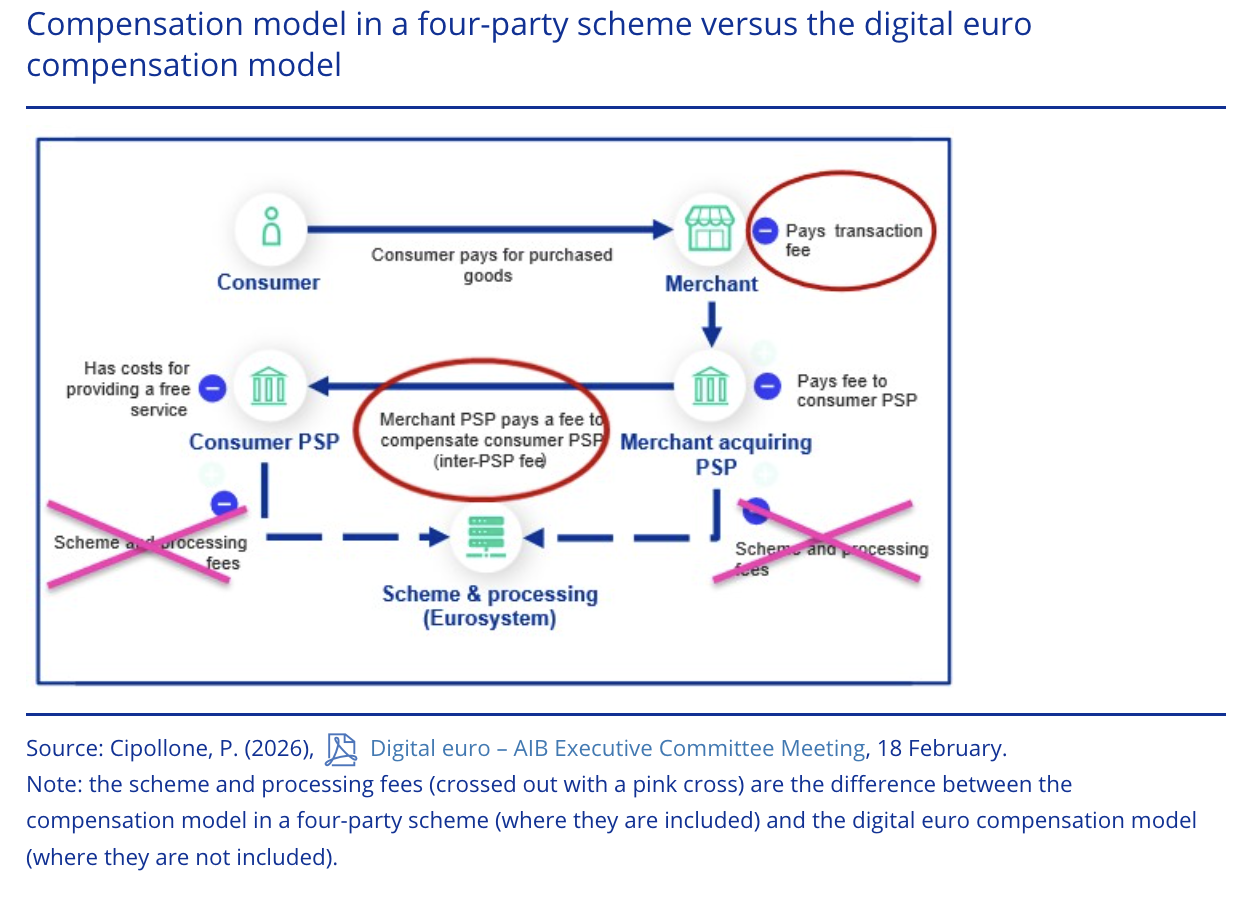
Under the plan, banks would run digital euro accounts and maintain customer relationships, allowing them to keep data needed for credit assessments. The officials wrote that the compensation model in the European Commission’s draft regulation would pay banks for services. The Eurosystem would not charge scheme or processing fees.
The digital euro is intended to be usable anywhere in the euro area and to provide a common payment infrastructure for new products. Tests on the ECB’s innovation platform highlighted “conditional payments,” in which money moves only when preset conditions are met, such as a ticket payment that settles only if a train departs. Banks could build services on top of the base payment layer.
To reinforce bank offerings, the post points to co-badging with domestic card schemes and to common European standards for account-to-account payments. Co-badged debit cards could work across the euro area without defaulting to international networks. Today, 13 of 21 euro area countries depend entirely on international card schemes or mobile solutions for in-store payments, and more than half lack a widely accepted domestic e-commerce option. Non-European card schemes account for about two-thirds of card transactions. With legal tender status, common standards aim to give bank wallets instant reach and reduce reliance on big tech wallets that charge fees. “The digital euro would play a similar role for payments in Europe,” the officials wrote.
The Eurosystem expects to announce European standards by summer and to work with market participants to embed them in terminals, though finalization depends on legislation. That process is running in parallel with the ECB’s work on digital euro ATM rules, as legal certainty from the law would allow private initiatives to use the digital euro front end before issuance, while merchants upgrading terminals could make devices digital-euro ready.
On stability, the officials outlined safeguards: the digital euro would not pay interest; a “reverse waterfall” mechanism would route excess balances back to users’ bank accounts; and holding limits would apply to individuals, while companies would not be allowed to hold digital euro. ECB analysis based on banks’ data found limited effects on deposits, liquidity and profitability in normal times and manageable impacts in severe stress, smaller than those in the 2019 liquidity stress test.
Cost estimates shared by the ECB, based on input from some banks, put total bank investment at €4 billion to €5.8 billion over four years, or €1 billion to €1.44 billion per year. The central bank said this equals roughly 3.4% of significant banks’ annual IT upgrade budgets and could fall through synergies and cost mutualization. The post notes that banks today pay fees to international card schemes and big tech mobile wallets, and face the risk of losing fees, data and deposits to stablecoins.
A pilot is planned for 2027 to test the infrastructure in real-life conditions and to inform implementation choices. Participating banks would advise on integration, reuse of existing components, and whether to build capabilities internally or with partners. “We are determined to make it a shared success,” they wrote.
The content on The Coinomist is for informational purposes only and should not be interpreted as financial advice. While we strive to provide accurate and up-to-date information, we do not guarantee the accuracy, completeness, or reliability of any content. Neither we accept liability for any errors or omissions in the information provided or for any financial losses incurred as a result of relying on this information. Actions based on this content are at your own risk. Always do your own research and consult a professional. See our Terms, Privacy Policy, and Disclaimers for more details.
Articles by this author