December 2025 blockchain events spotlight DeFi, NFTs, adoption

Two major blockchain conferences scheduled for December 2025 in Abu Dhabi and India will address decentralized finance evolution, NFT applications, and cross-sector blockchain implementations. Events feature speakers from Animoca Brands, 1inch, Polygon, Astar Network, and Aptos.
December 2025 concludes the year's blockchain conference calendar with two events addressing decentralized technology applications, regulatory frameworks, and industry-specific blockchain solutions. Global Blockchain Show Abu Dhabi and India Blockchain Week provide platforms for protocol developers, investors, and enterprise blockchain implementers to examine current deployment challenges and emerging use cases.
Global Blockchain Show Abu Dhabi: December 10-11
The second edition of Global Blockchain Show Abu Dhabi is scheduled for December 10-11, 2025. Organizers project over 5,000 attendees with 200+ speakers who will address blockchain technology applications, Web3 infrastructure, and decentralized systems.
Confirmed speakers include Yat Siu, Co-Founder and Chairman of Animoca Brands, and Sergej Kunz, Co-Founder of 1inch. Programming will address blockchain gaming ecosystems, decentralized exchange infrastructure, and venture investment in blockchain projects.
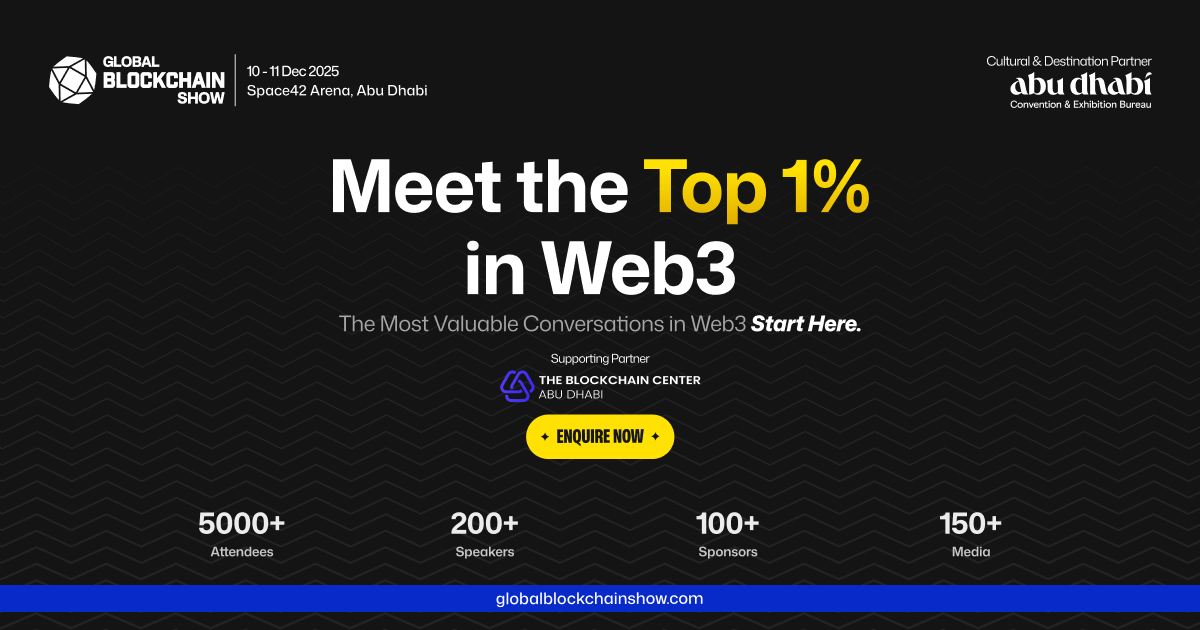
The event offers three ticket tiers: VIP Pass, Festival Plus Pass, and Festival Pass, with pricing differentiated by networking access and session availability. The Abu Dhabi location places the conference within the UAE's regulatory framework for digital assets, overseen by the Virtual Assets Regulatory Authority (VARA).
Animoca Brands' presence reflects blockchain gaming sector interest, particularly around NFT integration in interactive entertainment and play-to-earn economic models. 1inch's participation addresses decentralized exchange aggregation technology and automated market maker (AMM) optimization strategies.
India Blockchain Week: December 2-3
India Blockchain Week runs December 2-3, 2025, incorporating multiple sub-events including Polygon Connect and ETHIndia. The conference expects 2,500+ attendees and 135+ speakers addressing blockchain infrastructure development and regulatory trends.
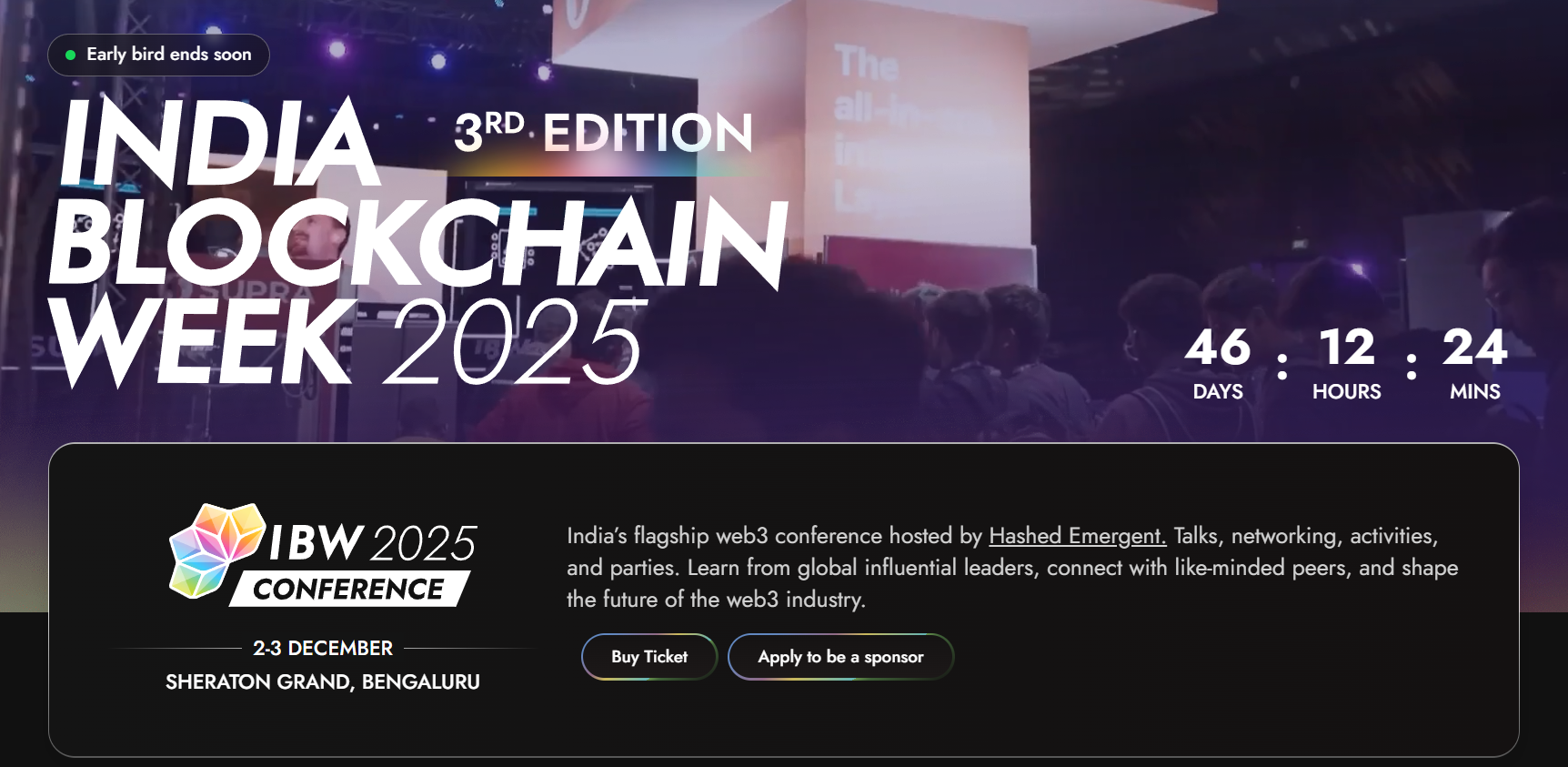
Speaker lineup includes:
- Sandeep Nailwal, Founder of Polygon
- Sota Watanabe, Co-Founder of Astar Network
- Avery Ching, Co-Founder of Aptos
Programming focuses on Layer-2 scaling solutions, consensus algorithm developments, and blockchain implementation across finance, healthcare, and supply chain sectors. The India venue provides context for discussions around regulatory approaches to cryptocurrency and blockchain in major emerging markets.
Polygon's participation centers on zero-knowledge proof technology and Ethereum scaling infrastructure. Astar Network discusses parachain functionality within the Polkadot ecosystem and cross-chain interoperability. Aptos brings perspective on Move programming language adoption and parallel execution blockchain architecture.
Key themes across December conferences
Both events structure programming around several recurring blockchain industry topics:
DeFi infrastructure evolution
Decentralized finance protocols continue evolving beyond simple token swaps toward more complex financial primitives. Current DeFi discussions address lending protocol economics, algorithmic stablecoin mechanisms, and institutional DeFi adoption barriers. Risk management in DeFi – particularly around smart contract vulnerabilities and economic exploits – remains a central concern as total value locked (TVL) in protocols grows.
NFT utility expansion
NFT applications are expanding beyond digital collectibles into ticketing, certification, digital identity, and intellectual property management. Conferences will examine NFT royalty enforcement mechanisms, metadata storage solutions, and integration with physical asset ownership records. The discussion has shifted from speculative NFT trading toward practical utility in verifiable credentials and access rights management.
Enterprise blockchain adoption
Real-world blockchain implementations in supply chain, healthcare records, and financial settlement continue developing. Conferences address permissioned blockchain architectures, hybrid public-private network designs, and integration challenges with legacy enterprise systems. Case studies typically cover traceability applications, interorganizational data sharing, and settlement efficiency improvements.
Regulatory framework development
Blockchain conferences increasingly incorporate regulatory discussions as jurisdictions worldwide implement cryptocurrency and digital asset regulations. Topics include compliance strategies for decentralized protocols, cross-border regulatory harmonization efforts, and regulatory technology (RegTech) solutions for blockchain operations.
Consensus algorithm innovations
Beyond Proof-of-Work and Proof-of-Stake, newer consensus mechanisms address specific use cases. Discussions cover Byzantine Fault Tolerance (BFT) variants, directed acyclic graph (DAG) architectures, and hybrid consensus models balancing decentralization, security, and transaction throughput.
Geographic distribution of blockchain development
The December conference locations reflect regional blockchain ecosystem characteristics:
UAE regulatory positioning: Abu Dhabi and Dubai have established licensing frameworks for cryptocurrency exchanges and blockchain enterprises through VARA. The regulatory clarity has attracted international blockchain companies to establish Middle East operations, particularly for serving markets where regulatory frameworks remain unclear.
India's blockchain ambiguity: India maintains complex positioning on cryptocurrency regulation while supporting blockchain technology development. The country's large developer community and growing startup ecosystem make it significant for blockchain protocol development, despite ongoing uncertainty around cryptocurrency legal status.
Conference networking infrastructure
Productive blockchain conferences provide structured networking beyond scheduled presentations:
- Targeted meeting scheduling: pre-conference platforms allowing attendees to schedule meetings with specific participants based on professional interests
- Topic-specific breakouts: smaller sessions organized around technical topics (consensus mechanisms, smart contract security) or industry applications (supply chain, DeFi)
- Hackathons and workshops: hands-on programming sessions where developers collaborate on protocol implementations or application prototypes
- Investor pitch sessions: structured opportunities for blockchain startups to present to venture investors and strategic partners
The effectiveness of these networking mechanisms varies significantly across conferences. Well-organized events facilitate high-value connections between protocol developers, enterprise blockchain implementers, and investors. Poorly structured conferences rely on chance encounters in crowded exhibition halls.
Blockchain implementation challenges
Current blockchain deployments face several persistent challenges that conference programming addresses:
Scalability limitations: Layer-1 blockchains continue facing transaction throughput constraints. Layer-2 solutions – including optimistic rollups, zero-knowledge rollups, and state channels – attempt to address scaling while maintaining security properties of underlying chains.
Interoperability gaps: cross-chain communication remains complex, with multiple competing bridge architectures introducing security and user experience challenges. Conferences explore cross-chain messaging protocols, wrapped asset mechanisms, and chain-agnostic application architectures.
User experience friction: blockchain application interfaces remain challenging for non-technical users. Key management, transaction signing, and gas fee mechanics create barriers to mainstream adoption. Programming addresses account abstraction, social recovery mechanisms, and gasless transaction sponsorship.
Smart contract security: high-profile exploits continue affecting DeFi protocols and NFT projects. Conferences cover formal verification methods, automated vulnerability scanning, and economic attack modeling for protocol design.
Industry maturation indicators
December 2025 blockchain conferences reflect industry evolution beyond early-stage hype:
- Enterprise participation increasing alongside cryptocurrency-native companies
- Regulatory compliance sessions receiving equal billing with technical protocol discussions
- Focus on measurable adoption metrics rather than total addressable market projections
- Case studies emphasizing operational improvements over revolutionary disruption narratives
- Integration challenges with existing systems receiving attention alongside greenfield implementations
This maturation appears in speaker selections emphasizing protocol developers and enterprise implementers over influencer personalities, and in programming addressing specific technical challenges rather than broad blockchain evangelism.
December 2025 blockchain conference schedule:
December 2-3: India Blockchain Week (multiple sub-events including Polygon Connect, ETHIndia)
December 10-11: Global Blockchain Show Abu Dhabi
Key speakers:
- Yat Siu (Animoca Brands)
- Sergej Kunz (1inch)
- Sandeep Nailwal (Polygon)
- Sota Watanabe (Astar Network)
- Avery Ching (Aptos)
Event details: Global Blockchain Show Abu Dhabi
Tickets: https://www.globalblockchainshow.com/abu-dhabi/tickets/
The content on The Coinomist is for informational purposes only and should not be interpreted as financial advice. While we strive to provide accurate and up-to-date information, we do not guarantee the accuracy, completeness, or reliability of any content. Neither we accept liability for any errors or omissions in the information provided or for any financial losses incurred as a result of relying on this information. Actions based on this content are at your own risk. Always do your own research and consult a professional. See our Terms, Privacy Policy, and Disclaimers for more details.
Articles by this author