Alison Mangiero Presses SEC for Guidance on Crypto Staking

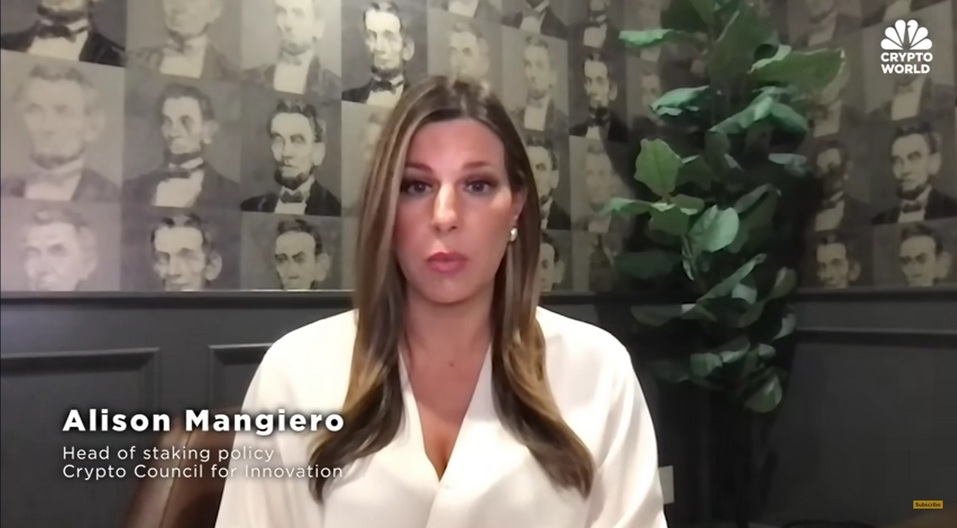
Alison Mangiero of the Crypto Council explains why staking isn’t lending—and why the SEC needs to say so.
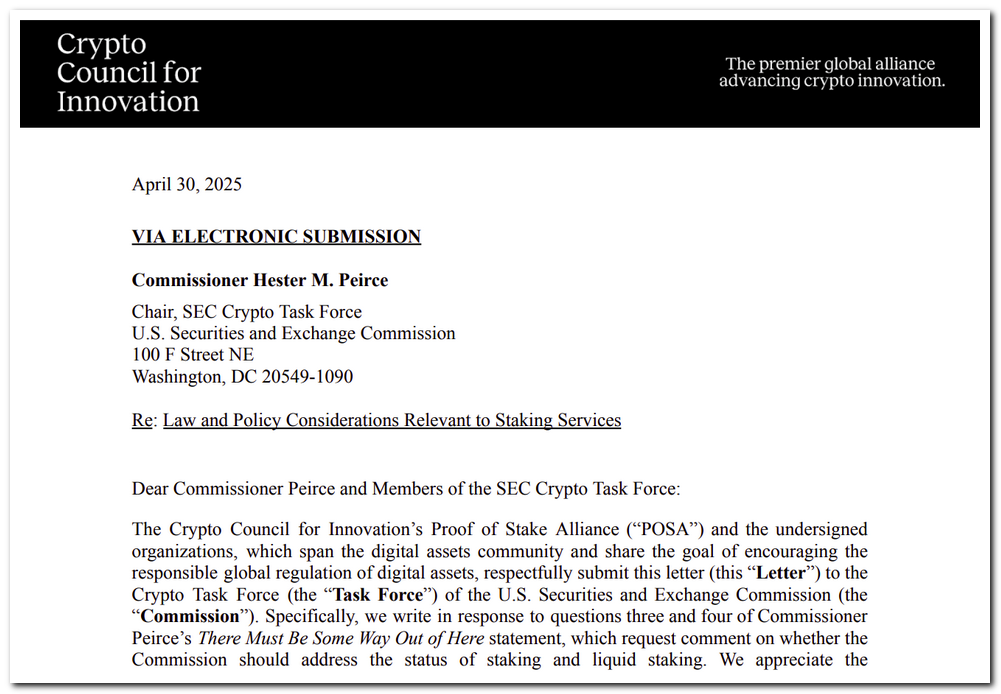
After years of uncertainty and courtroom drama, crypto’s relationship with U.S. regulators may finally be thawing. This month, a powerful coalition led by the Crypto Council for Innovation (CCI) sent a formal letter to the Securities and Exchange Commission, urging it to clarify one of the industry’s most misunderstood practices: staking.
And this time, the SEC might actually be listening.
Staking Is Not Lending, CCI Argues
Alison Mangiero, Head of Staking Policy at CCI, says the message is simple: staking is a technical function, not an investment contract.
You’re locking up tokens to perform a network function, not handing them over to earn interest. That’s a world of difference,
she explains.
In a post-letter interview, Mangiero outlined two core requests from the Council:
- Principle-based guidance
The SEC should issue guidance similar to its March 2025 statement on Proof-of-Work mining, which held that mining does not trigger securities laws because it involves no managerial reliance or profit expectation from third parties.
- Equal treatment for staking
Like miners, stakers contribute resources—locked tokens instead of computing power—to secure public networks. The reward system is automated and governed by protocol rules, not corporate discretion.
We think the same analysis applies. This is a ministerial, administrative activity—one that should fall outside the scope of securities law,
Mangiero argues.
Behind the Letter: Industry Push for Clarity
The letter is backed by more than thirty crypto firms, including:
- Coinbase,
- Kraken,
- Circle,
- Fidelity.
While staking has existed for years on proof-of-stake blockchains, its regulatory treatment remains murky. U.S. exchanges have faced scrutiny for offering staking-as-a-service, with some—like Kraken—paying fines to settle allegations of unregistered securities offerings.
CCI’s goal is to prevent a repeat of that pattern and avoid regulation by enforcement. The Council also provided the SEC with risk-mitigation principles, designed to protect users of staking services without triggering securities classification.
The stakes are high. Mangiero noted that the staking market has exploded from just $19 million to over $600 billion in recent years. Yet U.S. investors still face uncertainty on whether participation puts them in legal jeopardy.
Why the Timing Matters
What’s changed? According to Mangiero, the regulatory tone in Washington has shifted decisively in 2025.
We’ve seen more constructive engagement in the last four months than in the last four years,
she notes.
The turning point came in January with the creation of the SEC Crypto Task Force and a series of public roundtables, dubbed the agency’s “spring sprint toward crypto clarity.”
Discussion topics have included:
- Custody,
- DeFi,
- Staking,
- And broader market structure questions.
This regulatory momentum has coincided with two major shifts:
- A new administration in the White House,
- Appointment of Paul Atkins as SEC Chair, viewed as far more crypto-friendly than his predecessor, Gary Gensler.
Since Gensler’s departure on Inauguration Day, the SEC has:
- dropped,
- paused,
- or resolved several high-profile cases, including those involving Ripple, Coinbase, and Kraken.
There’s real energy now. The staff are engaging, roundtables are happening, and the industry is showing up ready to participate,
Mangiero observed.
A Bipartisan Signal from Congress
The SEC isn't alone in re-evaluating staking. Senator Cynthia Lummis, chair of the Senate Banking Subcommittee on Digital Assets, recently raised concerns about the exclusion of staking from crypto ETF applications—a decision Alison Mangiero previously described as ‘discouraging and confusing.
Now, Lummis and others are publicly pressing the SEC to reconsider. Mangiero welcomed this rare bipartisan attention to crypto infrastructure, especially on a topic as technical and misunderstood as staking.
It’s encouraging to see lawmakers ask: why was staking removed, and what would it take to include it?
She noted that other jurisdictions—including the UK and Canada—have already issued public guidance on staking. Without similar clarity in the U.S., institutional players are left on the sidelines.

Post-Gensler, a New Playbook
Reflecting on the previous administration’s approach, Mangiero drew a sharp line:
We went from enforcement, enforcement, enforcement—to actual dialogue.
She criticized attempts under Gensler to lump staking in with lending, arguing that the two involve fundamentally different mechanics and risks.
With lending, you give up control of your assets. With staking, you use your assets to participate in the protocol.
Mangiero also pointed to the dismissal of the SEC’s case against Coinbase—with prejudice—as a clear signal that past assumptions about staking as securities offerings are starting to break down.
The Next 100 Days
As the crypto community marks the first 100 days of Trump’s second term, Mangiero remains cautiously optimistic.
She praised the administration’s early moves, including:
- Creation of a strategic Bitcoin reserve
- Launch of a new Crypto Task Force
- Introduction of two stablecoin bills in Congress
We’ve made progress, but we’re not done. There’s still time to get staking policy right—and it starts with the SEC.
Whether the agency will respond with the clarity the industry is asking for remains to be seen.
But one thing is certain: staking is no longer a footnote. It’s a front-line issue in the battle to define crypto’s regulatory future.
The content on The Coinomist is for informational purposes only and should not be interpreted as financial advice. While we strive to provide accurate and up-to-date information, we do not guarantee the accuracy, completeness, or reliability of any content. Neither we accept liability for any errors or omissions in the information provided or for any financial losses incurred as a result of relying on this information. Actions based on this content are at your own risk. Always do your own research and consult a professional. See our Terms, Privacy Policy, and Disclaimers for more details.
Articles by this author