

Why Is $BTC Dropping? Trump’s Tariff Shock and the Big Tech Meltdown

The escalating U.S.–China trade war and a tech stock downturn have created a perfect storm. Crypto investors are moving to cash as BTC breaks through key support levels.
Late on April 3, Bitcoin (BTC) plunged 7%, falling from $88,500 to $82,100. This marked its steepest single-day drop in weeks. The cryptocurrency is now trading in the $82,300–$81,200 support range, a zone that has yet to show meaningful buyer interest.
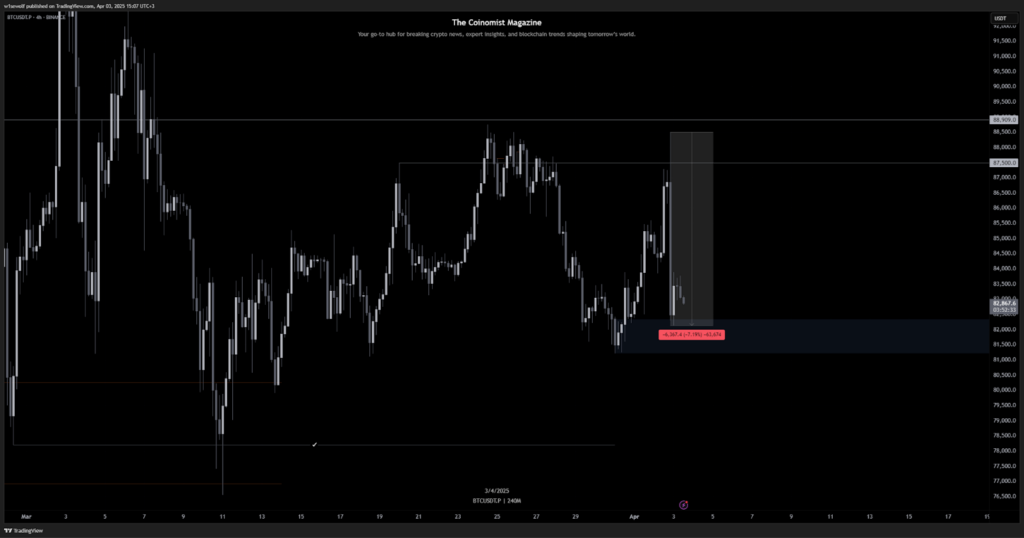
In light of the news and widespread market sell-offs, traders seem to be losing confidence in a quick recovery. With risk appetite fading, Bitcoin is under pressure alongside other assets.
Trump Launches Global Tariffs, Markets Slide in Response
The sharp drop in Bitcoin was primarily triggered by President Donald Trump’s announcement of sweeping a new 10% baseline tariff on all imports, along with higher rates of up to 54% on products from China, the EU, Japan, India, and several other countries.
This is the largest trade reform in decades, which Trump called “American Economic Independence Day”.

Related: What Are Trump’s Tariffs: A New Blow to the Economy?
Markets interpreted the announcement as a serious threat to global economic stability. Moreover, analysts have called the White House’s move an “economic bomb,” and investors rushed to exit risk assets. According to the head of Fitch US Economics, these measures could push the global economy into recession and slow the U.S. economy as early as Q2.
Following the announcement:
- Stock futures tumbled
- Asian markets opened in the red (Nikkei -4%, ASX -2%)
Meanwhile, the crypto market also took a hit, as traders began to:
- Exit open positions
- Move into alternative assets for hedging
- Withdraw liquidity from BTC and altcoins
Big Tech Sell-Off Deepens the Flight from Risk Assets
The market took another hit as the U.S. tech sector posted sharp losses. By the end of Q1 2025, the Nasdaq had fallen 10.4%, while the S&P 500 was down 4.6%, marking the worst quarterly performance since autumn 2022.
However, the biggest blow hit the stocks of the so-called “Magnificent Seven” (Apple, Microsoft, Tesla, Amazon, and others).
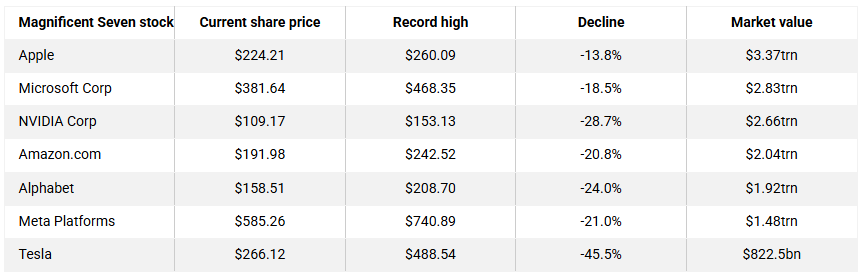
Since early 2025, these seven companies have collectively lost $4.48 trillion in market capitalization:
- Tesla dropped 45%
- NVIDIA fell 29%
- Alphabet declined 24%
The Big Tech sell-off reflects a sharp erosion of investor confidence in high-risk assets, directly impacting the cryptocurrency market.
As a result, diminished liquidity and a worsening macroeconomic outlook pushed Bitcoin below $83,000, accelerating the broader sell-off and driving the price toward a critical support level.
Related: Crypto Markets Brace for Tariff Shockwave from Trump
What’s Next: A Turbulent Phase and the Wait for Stabilization
The current level of $82,100 is a key zone for short-term market structure. Meanwhile, a technical rebound remains possible from the $82,300–$81,200 range.
However, with rising trade tensions and falling stock indices, bullish momentum appears weak.
Traders are taking a wait-and-see approach. The market is leaning toward a period of sideways movement or short-term consolidation.
Base case: Bitcoin holds above $81,200 and enters a sideways range.
If downward pressure continues, the next major support zone lies between $78,600 and $77,000.
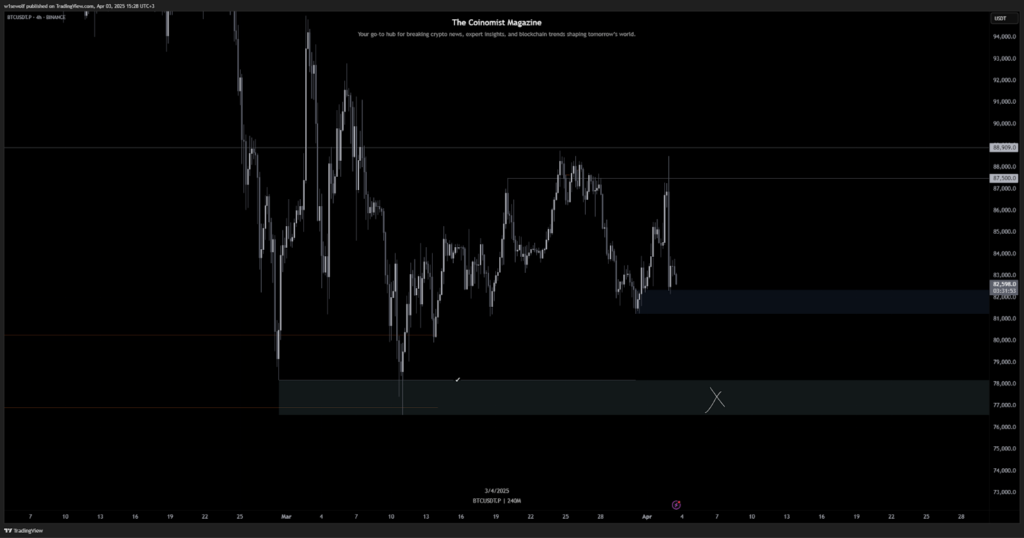
Overall, market sentiment remains defensive. Investors are reluctant to build new BTC positions, choosing instead to wait for signs of global stabilization.
The content on The Coinomist is for informational purposes only and should not be interpreted as financial advice. While we strive to provide accurate and up-to-date information, we do not guarantee the accuracy, completeness, or reliability of any content. Neither we accept liability for any errors or omissions in the information provided or for any financial losses incurred as a result of relying on this information. Actions based on this content are at your own risk. Always do your own research and consult a professional. See our Terms, Privacy Policy, and Disclaimers for more details.
Articles by this author







