SEC files 456 cases in FY 2025, reports $17.9B in relief
The SEC reported 456 enforcement actions in FY 2025, with $17.9B in orders, a focus on fraud, and the dismissal of seven crypto cases brought under prior leadership.
The Securities and Exchange Commission reported 456 enforcement actions in fiscal 2025, including 303 standalone cases and 69 follow-on administrative proceedings, with orders for $17.9 billion in monetary relief. The agency emphasized investor protection and fraud-focused cases, and dismissed seven crypto asset lawsuits filed under prior leadership.
The SEC characterized fiscal 2025 as a transition away from volume-driven case counts and novel legal theories. Resources were directed to offering frauds, market manipulation, insider trading, issuer disclosure violations, and fiduciary duty breaches by investment advisers. Investigators also opened and closed 1,095 additional matters, and noted several instances where firms remediated practices without formal actions.
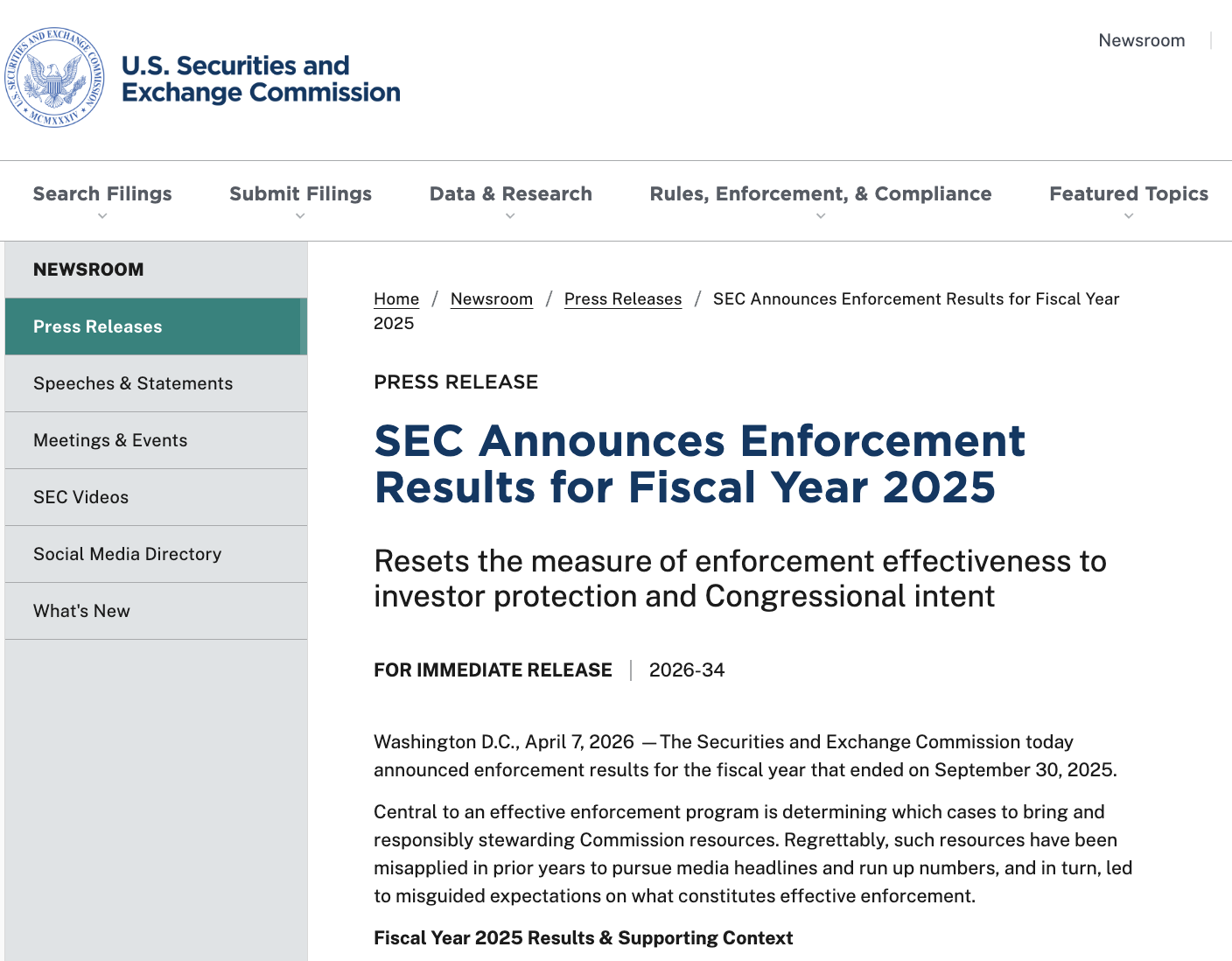
Of the $17.9 billion in ordered relief, $10.8 billion reflected disgorgement and prejudgment interest and $7.2 billion were civil penalties. Some disgorgement amounts were deemed satisfied by orders in separate non-SEC cases. Excluding those and judgments tied to the Stanford Ponzi case, fiscal 2025 totals were $1.4 billion in disgorgement and interest and $1.3 billion in penalties. The SEC returned about $262 million to investors and issued roughly $60 million to 48 whistleblowers. The agency received a record 53,753 tips, complaints, and referrals, up nearly 19% year over year. Some parties that self-reported, cooperated, or remediated received reduced penalties or were not charged.
The Commission reported increased attention on individual accountability. About two-thirds of standalone cases included charges against one or more people, a 27% increase from the prior year. Nearly nine in ten standalone actions filed under Acting Chair Mark Uyeda and Chair Paul Atkins included individual charges. Orders barred 119 people from serving as public-company officers or directors.
Crypto enforcement shifted in February 2025, when the agency launched a Cyber and Emerging Technologies Unit to work with the Crypto Task Force. The SEC dismissed seven crypto asset registration cases filed earlier by the prior Commission, including actions involving Coinbase, Consensys Software, Payward (Kraken), Binance, Dragonchain, Balina, and Cumberland DRW LLC.
| Case | Status | Date Resolved |
| SEC vs. Coinbase | Dismissed | Feb 2025 |
| SEC vs. Binance | Stayed/Resolved | Early 2026 |
| SEC vs. Ripple | Appeals dropped, $125M fine | Aug 2025 |
| SEC vs. Gemini | Dismissed | Jan 2026 |
Retail investor matters featured prominently. The SEC brought cases tied to an alleged $400 million Ponzi scheme involving Paramount Management Group and Prestige Investment Group and their founder Daryl F. Heller; an alleged $140 million scheme by First Liberty Building & Loan and owner Edwin Brant Frost IV; and a case alleging Nightingale Properties and founder Elchonon “Elie” Schwartz raised $60 million and misappropriated more than $52 million. The agency charged Allarity Therapeutics with disclosure failures related to an FDA critique, and alleged Vanguard Advisers did not adequately disclose conflicts when recommending a fee-based advisory service.
To address cross-border risks, a Cross-Border Task Force formed in September 2025 to pursue account takeovers and manipulative schemes tied to foreign-based actors. Trading cases in 2025 included spoofing charges against a California resident who allegedly gained about $234,000, and insider trading complaints involving a former biopharma vice president of drug safety, a former investor relations executive and two associates, and a former head of equity trading at an investment firm.
Trial and court results included a jury finding Steven M. Gallagher liable for securities fraud and manipulative trading in a Twitter-based microcap scheme that generated more than $2.6 million in profits; a verdict against Thomas F. Casey for inducing over 200 investors to put more than $10 million into Golden Genesis based on false promises; and a verdict finding adviser Jeffrey Cutter and Cutter Financial Group liable under Section 206(2) of the Advisers Act. On summary judgment, a court found Matthew Brown and his company liable for touting a bogus $200 million investment offer to Virgin Orbit using a fabricated bank screenshot, and another court found recidivist Marshall Melton and a controlled business liable for antifraud violations in a real estate offering and for failing to disclose Melton’s disciplinary history.
Over the past year, the Commission has put a stop to regulation by enforcement and recentered its enforcement program on the Commission’s core mission by prioritizing cases that provide meaningful investor protection and strengthen market integrity, Chair Paul S. Atkins stated.
Commissioner Mark T. Uyeda noted, “We will remain focused on coherent and transparent policymaking, as well as meaningful engagement with market participants to promote compliance, and wield the authority of enforcement in a more appropriate manner, guided by investor protection above all.”
The content on The Coinomist is for informational purposes only and should not be interpreted as financial advice. While we strive to provide accurate and up-to-date information, we do not guarantee the accuracy, completeness, or reliability of any content. Neither we accept liability for any errors or omissions in the information provided or for any financial losses incurred as a result of relying on this information. Actions based on this content are at your own risk. Always do your own research and consult a professional. See our Terms, Privacy Policy, and Disclaimers for more details.
Articles by this author