Why Latin America Is Banking on Stablecoins

A new report from Mexican crypto exchange Bitso reveals that over the past year, USDT and USDC have become the most popular digital assets in Latin America, fueled by growing concerns over economic instability.
The primary drivers of crypto adoption in Latin America remain inflation protection and investment opportunities. However, stablecoins have taken the top spot, with USDT and USDC making up a significant 39% of all purchases on the platform.
For comparison, Bitcoin (BTC) investments account for 22%, while Ethereum (ETH) and Ripple (XRP) stand at 5% and 9%, respectively.
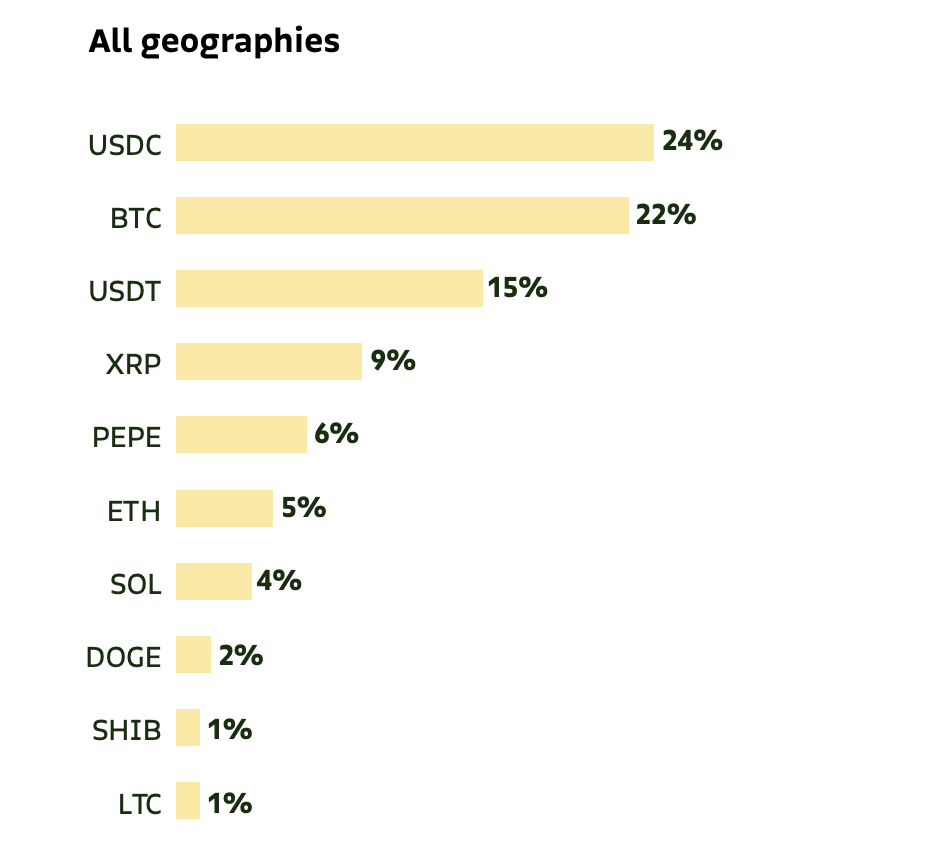
As stablecoins gain traction, Bitcoin’s share of crypto purchases in Latin America has dropped 6% year-over-year. The reason? Many investors, encouraged by Bitcoin’s late-2024 price spike, have opted to HODL rather than trade.
Still, Bitcoin remains dominant in the average investor’s portfolio, making up 49% of holdings, while fiat and stablecoins account for just 6%.
Drivers Behind the Stablecoin Surge
It’s not just inflation driving Latin Americans toward crypto—the region is grappling with rising unemployment, shrinking exports, and financial uncertainty, all of which are pushing more people toward alternative assets.
USD-backed stablecoins have become the go-to choice, offering stability in an unpredictable economy. With the U.S. dollar still the world’s most trusted currency, it’s no surprise that stablecoins pegged to it are thriving.
Beyond acting as a hedging tool or a trading asset, stablecoins have become a key enabler of international transactions. Their USD peg and high transparency streamline cross-border payments, cutting conversion costs and improving transaction speed.
As stablecoins prove their efficiency and reliability, financial institutions are increasingly integrating them into global payment systems, further bridging the gap between traditional finance and digital assets.
Check this out: How to Make Money in Crypto: Top Strategies for Beginners
Latin America's Market Crypto Divide
Crypto adoption in Latin America isn’t one-size-fits-all—investment trends vary significantly from country to country.
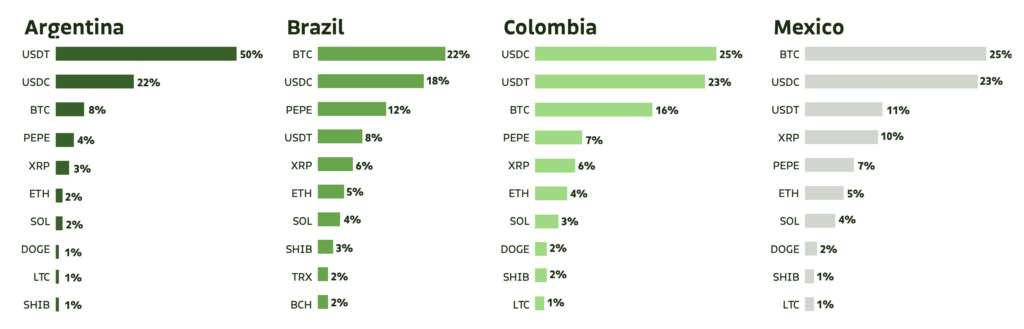
In Argentina, USDT is king, accounting for a massive 50% of total crypto purchases, while USDC claims 22%. Surprisingly, Bitcoin’s share is just 8%.
By contrast, Brazil and Mexico still favor Bitcoin, with 22% and 25% of total purchases, respectively. Stablecoins hold second place, with similar adoption rates across both markets.
The contrast in crypto investments across Latin America proves one thing—economic conditions dictate whether investors choose Bitcoin or stablecoins.
Related: Crypto Regulations in Argentina
Stablecoins and the Digital Shift in Latin America
Crypto adoption in Latin America remains uneven, ranging from 5% to 14%, with Brazil at just 6%.
However, analysts foresee stablecoins driving financial innovation, as regulatory frameworks solidify and infrastructure continues to evolve, setting the stage for a new era in digital finance.
The approval of ETFs and regulatory frameworks like MiCA could catalyze greater institutional involvement, leading to enhanced market stability and increased confidence among retail investors. However, in Latin America, this outcome will depend on the progression of local regulations, which remain diverse and inconsistent,
Bitso report reads.
Faced with economic uncertainty, Latin America is turning to stablecoins as a financial safety net.
As technology improves and regulations take shape, the region’s crypto market will expand, offering new investment frontiers for crypto funds and enterprises.
The content on The Coinomist is for informational purposes only and should not be interpreted as financial advice. While we strive to provide accurate and up-to-date information, we do not guarantee the accuracy, completeness, or reliability of any content. Neither we accept liability for any errors or omissions in the information provided or for any financial losses incurred as a result of relying on this information. Actions based on this content are at your own risk. Always do your own research and consult a professional. See our Terms, Privacy Policy, and Disclaimers for more details.
Articles by this author