IMF cuts 2026 global growth to 3.1% on Mideast risks

IMF cuts its 2026 global growth forecast to 3.1% from 3.3%, citing the Middle East conflict and higher oil prices that raise downside risks.
The International Monetary Fund lowered its 2026 global growth forecast to 3.1% from 3.3% in its latest World Economic Outlook, noting that the Middle East conflict and higher oil prices increase downside risks. The baseline projection already includes higher oil prices and a short-lived disruption; without Iran-related fallout the fund estimated growth would have been 3.4%.
The report lays out two risk scenarios. In an adverse case with oil at $100 a barrel, global growth would fall to about 2.5%. A severe case that assumes oil at $110 a barrel plus financial market stress would reduce growth to roughly 2.0%. IMF chief economist Pierre-Olivier Gourinchas called the severe outcome a ‘close call' for a global recession.
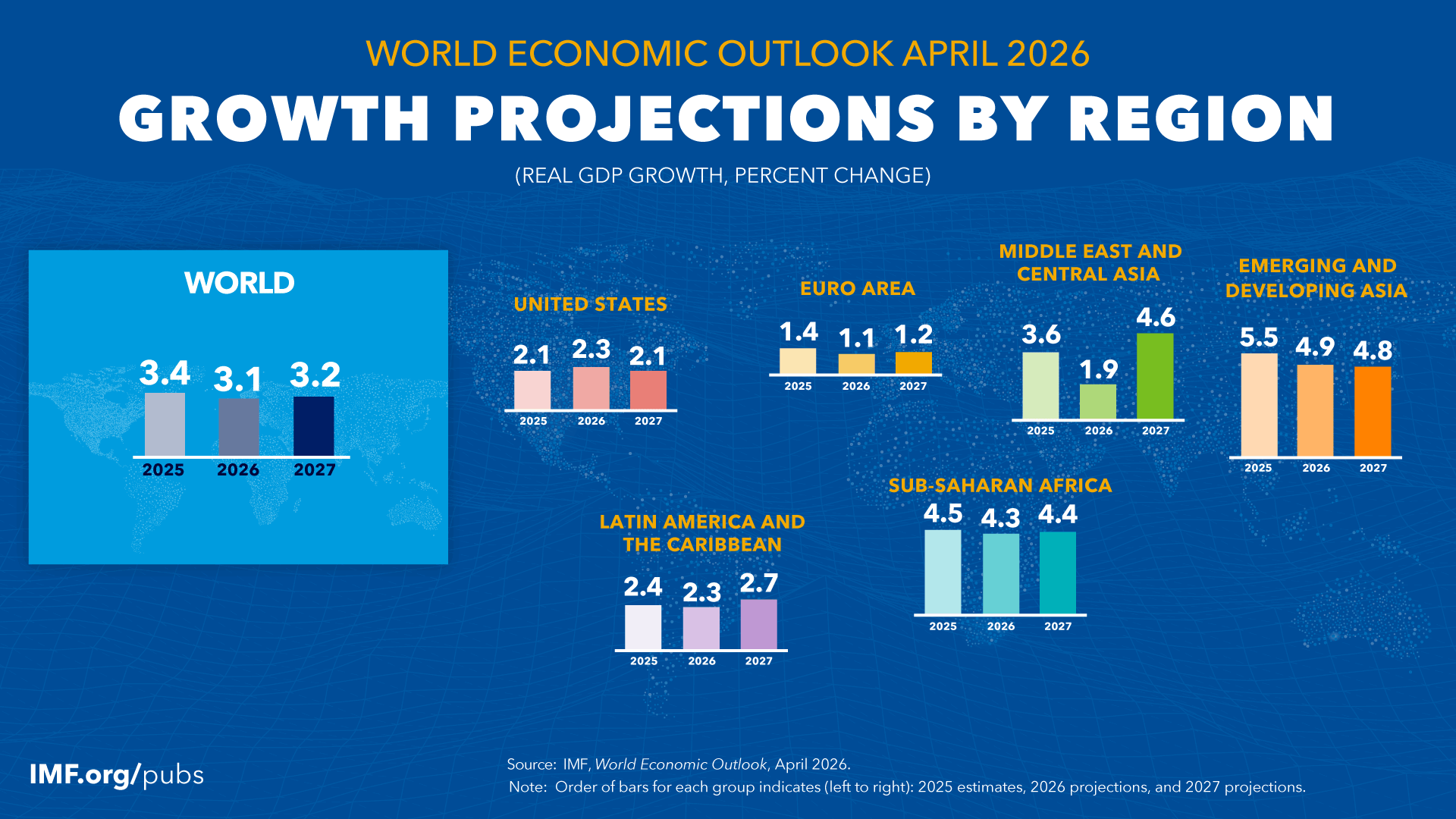
Country-level revisions were mixed. The United States was trimmed to 2.3% growth in 2026 from 2.4%; 2027 is now projected at 2.1% versus 2.0% previously. The euro area forecast was lowered to 1.1% from 1.3% as energy costs weigh on the region. China’s 2026 outlook was cut to 4.4% from 4.5%, with 2027 held at 4.0%. India’s growth was raised to 6.5% from 6.4%, a change the fund attributed to stronger domestic momentum and lower U.S. tariff rates. Turkey’s forecast was reduced to 3.4% from 4.2% on weaker momentum and higher energy prices. Iran faces the largest revision, with GDP now seen contracting 6.1% in 2026, a 7.2 percentage-point swing from the January projection. Japan’s 2026 forecast was unchanged at 0.7%, and the IMF signaled the Bank of Japan may tighten policy faster than markets expect.
Inflation projections were revised up. Global consumer price inflation under the baseline was raised to 4.4% from 3.8% in January. Inflation in emerging markets was increased to 5.5% from 4.8%. The IMF noted that elevated energy prices and wider price pressures could prompt some emerging-market central banks to delay planned rate cuts or reverse expected easing.
The fund emphasized that oil price paths and potential financial market disruptions are key determinants of the outlook. The baseline assumes a limited shock, while the adverse and severe scenarios illustrate how sustained higher energy costs and market stress could significantly lower growth.
The content on The Coinomist is for informational purposes only and should not be interpreted as financial advice. While we strive to provide accurate and up-to-date information, we do not guarantee the accuracy, completeness, or reliability of any content. Neither we accept liability for any errors or omissions in the information provided or for any financial losses incurred as a result of relying on this information. Actions based on this content are at your own risk. Always do your own research and consult a professional. See our Terms, Privacy Policy, and Disclaimers for more details.
Articles by this author