Bolivia Eyes El Salvador’s Crypto Path Amid Dollar Crisis

Facing dwindling reserves and a worsening fuel crisis, Bolivia turns to crypto – both at street level and through state policy – with El Salvador as a guide.
In mid-2025, Bolivia signed a cooperation agreement with El Salvador to jointly develop digital asset regulation and infrastructure. One year after repealing its crypto ban, Bolivia's Central Bank now describes digital currencies as a “viable and reliable alternative” to fiat currency. Crypto has shifted from a tolerated experiment to strategic policy.
From ban to blueprint: Bolivia looks to El Salvador
Bolivia’s memorandum of understanding with El Salvador, signed by the Bolivian Central Bank (BCB) and El Salvador’s National Commission of Digital Assets (CNAD), remains open-ended. The agreement outlines collaboration on crypto regulation, blockchain infrastructure, intelligence sharing, and capacity-building initiatives. CNAD will provide technical guidance, drawing from El Salvador’s pioneering experience with Bitcoin as legal tender.
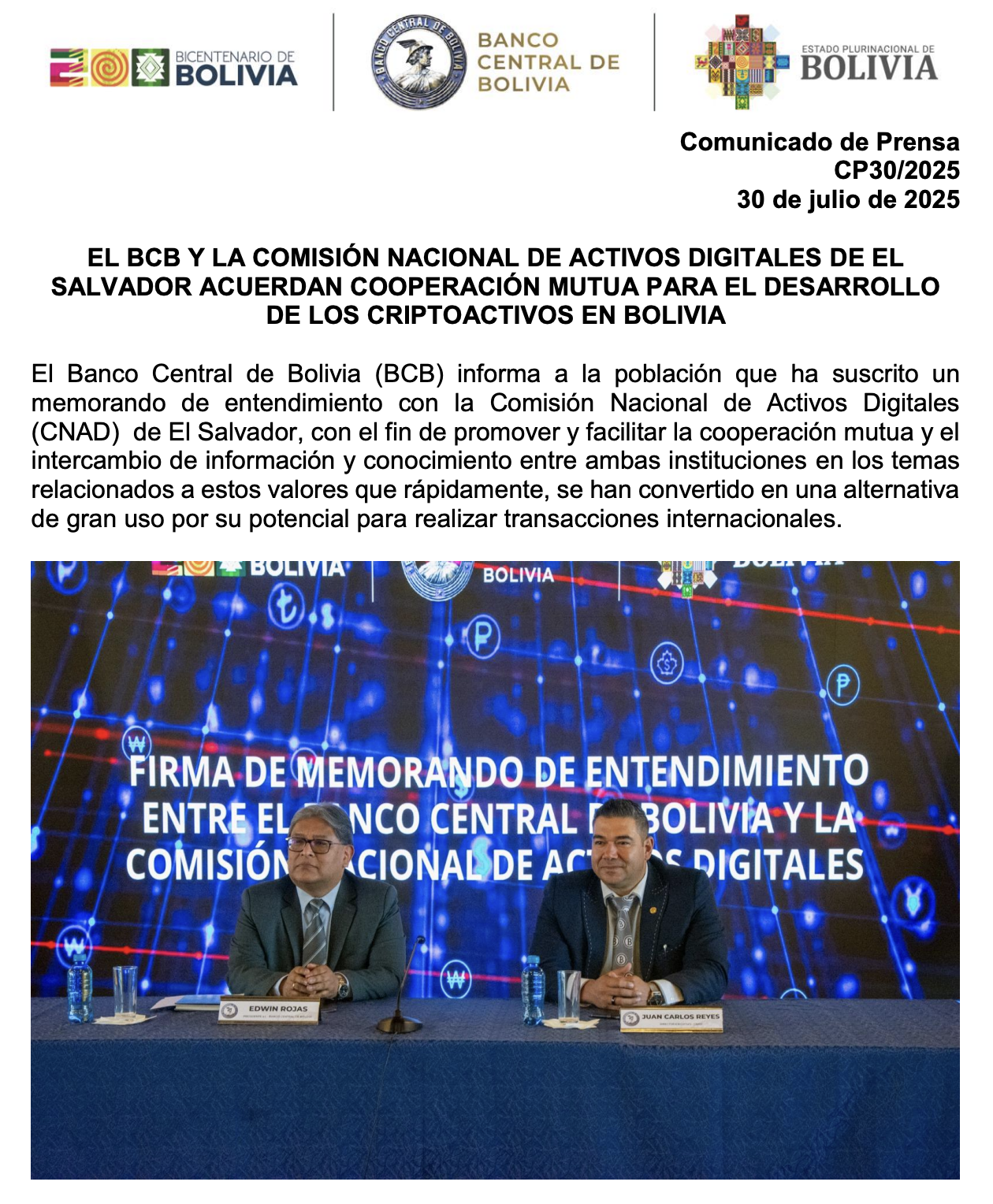
For Bolivia, this extends beyond diplomatic gestures. The BCB, once a vocal cryptocurrency opponent, now frames digital assets as a potential solution to structural challenges. In its official communication, the bank refers to them as “viable and reliable” instruments that can support small businesses and attract foreign investment.
Retail adoption came first
Bolivian users didn’t wait for regulation. After the crypto ban was lifted in June 2024, adoption surged. By mid-2025, crypto trading volume hit $294 million. USDT, Tether’s dollar-pegged stablecoin, gained particular popularity.
Tether CEO Paolo Ardoino described the shift as a “quietly revolutionary” moment, sharing photos of Bolivian shops displaying prices in USDT. Restaurants, barbershops, and service providers began accepting stablecoins directly. In some neighborhoods, digital dollars earned greater trust than the national currency.
According to former BCB president José Gabriel Espinoza, daily USDT transactions topped $600,000 this year. For a country with a rapidly shrinking supply of U.S. dollars, stablecoins offered liquidity, access, and inflation resistance.
Banking goes crypto: Banco Bisa launches USDT custody
Bolivia’s crypto normalization now extends beyond grassroots adoption. Banco Bisa, one of Bolivia's largest private banks, now offers USDT custody and transfer services. Launched in October 2024, the service allows customers to buy, hold, and send USDT abroad – with built-in compliance.
Our clients go through a rigorous verification process, which gives them peace of mind that their transactions are carried out through secure and reliable channels,
said Franco Urquidi, Vice President of Business at Banco Bisa.
The bank works with international custodians and crypto exchanges to ensure security and regulatory alignment. Bolivia’s financial regulator ASFI has formally endorsed the move, calling it a step toward safer participation in digital markets.
Fueling the economy with crypto: YPFB’s move
In March 2025, state-owned oil company YPFB confirmed plans to use cryptocurrencies for fuel imports. The decision came amid lengthy gas lines, scattered protests, and near-collapse of Bolivia’s foreign reserves – which plummeted from $12.7 billion in 2014 to just $165 million by April 2025.
While initial transactions haven't occurred, a YPFB spokesperson confirmed they are imminent:
From now on, these [cryptocurrency] transactions will be carried out.
The policy shift signals that digital assets are more than a hedge or convenience. For Bolivia, they’re becoming instruments of economic continuity in a context where the dollar is increasingly scarce.
What’s next: Lessons from El Salvador?
Bolivia closely monitors El Salvador’s experiment closely, using it as a guide while charting its own path.
El Salvador’s Bitcoin law, enacted in 2021, initially faced skepticism. Over time, it positioned the country as a crypto policy pioneer. Through CNAD, El Salvador now exports that expertise – offering Bolivia a template for regulation, risk management, ecosystem development, and institutional collaboration.
Whether Bolivia will legalize Bitcoin as legal tender remains uncertain. However, the trajectory is clear: from blanket prohibition to active experimentation, Bolivia is charting a crypto-native path through fiscal instability.
For Latin America, this represents more than technological experimentation. It’s become a monetary strategy, borderless infrastructure, political recalibration, and a test of regional sovereignty – one stablecoin at a time.
The content on The Coinomist is for informational purposes only and should not be interpreted as financial advice. While we strive to provide accurate and up-to-date information, we do not guarantee the accuracy, completeness, or reliability of any content. Neither we accept liability for any errors or omissions in the information provided or for any financial losses incurred as a result of relying on this information. Actions based on this content are at your own risk. Always do your own research and consult a professional. See our Terms, Privacy Policy, and Disclaimers for more details.
Articles by this author