U.S. adds 178,000 jobs in March; Jobless rate edges to 4.3%

U.S. employers added 178,000 jobs in March, led by a 76,000 rise in health care that included a 35,000 rebound in physician offices after a strike; the unemployment rate edged down to 4.3%.
The Bureau of Labor Statistics reported that U.S. nonfarm payrolls rose by 178,000 in March and the unemployment rate ticked down to 4.3% from 4.4%. Health care led hiring with a gain of 76,000, including a 35,000 rebound in offices of physicians as workers returned from a strike. Hospitals added 15,000 jobs. Over the past year, health care has averaged 29,000 new jobs per month.
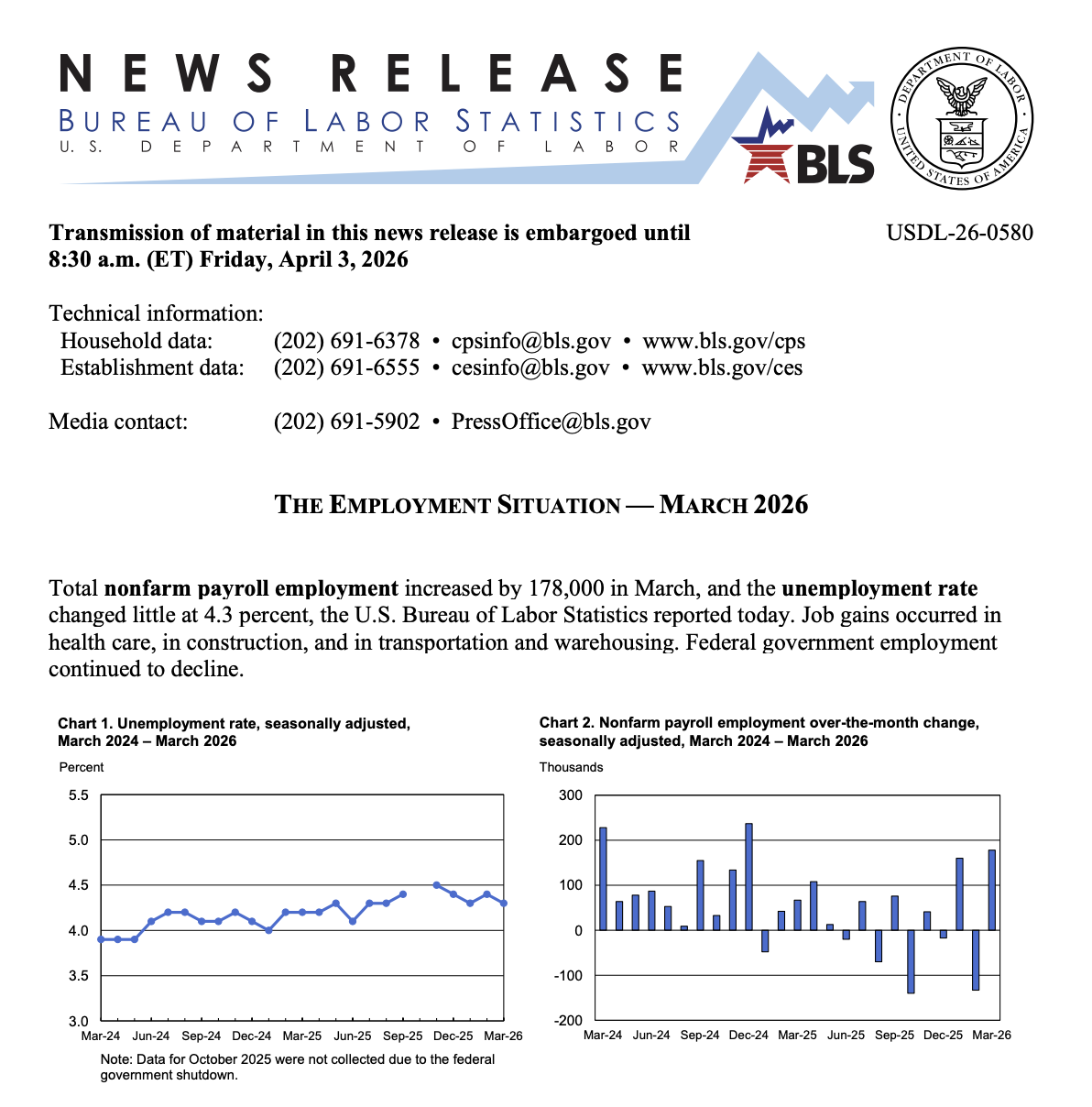
Total private payrolls increased by 186,000, while government employment declined by 8,000. Construction added 26,000 jobs. Transportation and warehousing rose by 21,000, driven by a 20,000 increase in couriers and messengers; employment in the broader sector remains 139,000 below its February 2025 peak. Social assistance rose by 14,000, mostly in individual and family services, up 11,000. Financial activities fell by 15,000, reflecting a 16,000 drop in finance and insurance; the sector is down 77,000 since May 2025. Federal government employment decreased by 18,000 and is 355,000, or 11.8%, below its October 2024 peak. Employment showed little change in mining and logging; manufacturing; wholesale and retail trade; information; professional and business services; leisure and hospitality; and other services.
Within private education and health services, employment rose by 91,000, including an 89,900 gain in health care and social assistance. Leisure and hospitality increased by 44,000.
Average hourly earnings for all private employees rose by 9 cents, or 0.2%, to $37.38 in March and were up 3.5% over the year. For production and nonsupervisory workers, average hourly pay increased by 5 cents to $32.07. The average workweek edged down by 0.1 hour to 34.2 hours. In manufacturing, the workweek held at 40.2 hours and overtime stayed at 3.0 hours. The average workweek for production and nonsupervisory employees was unchanged at 33.8 hours.

Household survey data showed the labor force decreased by 396,000, lowering the participation rate to 61.9% from 62.0% in February. The number of employed people slipped by 64,000 to 162.8 million, and the employment-population ratio ticked down to 59.2%. The number of unemployed people fell by 332,000 to 7.24 million. People working part time for economic reasons increased by 101,000 to 4.50 million. The number of people marginally attached to the labor force rose to 1.94 million, including 510,000 discouraged workers. The U-6 measure of labor underutilization was 8.0% in March.
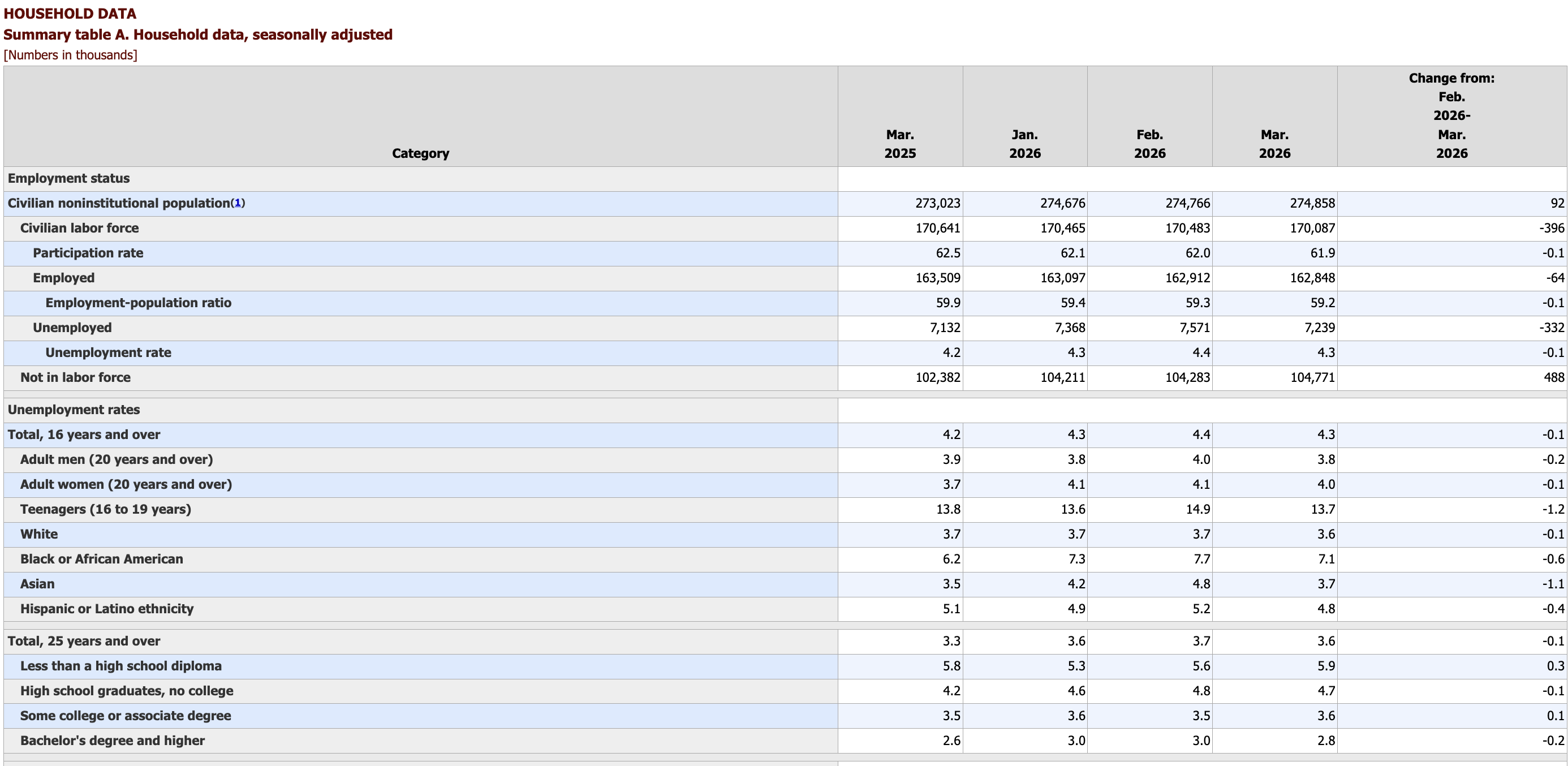
Unemployment rates by group declined: adult men 3.8% from 4.0%, adult women 4.0% from 4.1%, teenagers 13.7% from 14.9%, White 3.6% from 3.7%, Black 7.1% from 7.7%, Asian 3.7% from 4.8%, and Hispanic 4.8% from 5.2%. The number of long-term unemployed, those jobless for 27 weeks or more, fell by 78,000 to 1.82 million.
Revisions showed January payroll growth was revised up by 34,000 to 160,000, while February was revised down by 41,000 to a decline of 133,000. Combined, employment in January and February is 7,000 lower than previously reported. The three-month average change in total nonfarm payrolls was 68,000 in March. The private-sector diffusion index rose to 56.8.
The agency noted that federal employees on furlough during a partial government shutdown were counted as employed in the payroll survey if they worked or received, or will receive, pay for the pay period that included the 12th of the month.
The Employment Situation report for April is scheduled for release on Friday, May 8, 2026, at 8:30 a.m. ET.
The content on The Coinomist is for informational purposes only and should not be interpreted as financial advice. While we strive to provide accurate and up-to-date information, we do not guarantee the accuracy, completeness, or reliability of any content. Neither we accept liability for any errors or omissions in the information provided or for any financial losses incurred as a result of relying on this information. Actions based on this content are at your own risk. Always do your own research and consult a professional. See our Terms, Privacy Policy, and Disclaimers for more details.
Articles by this author