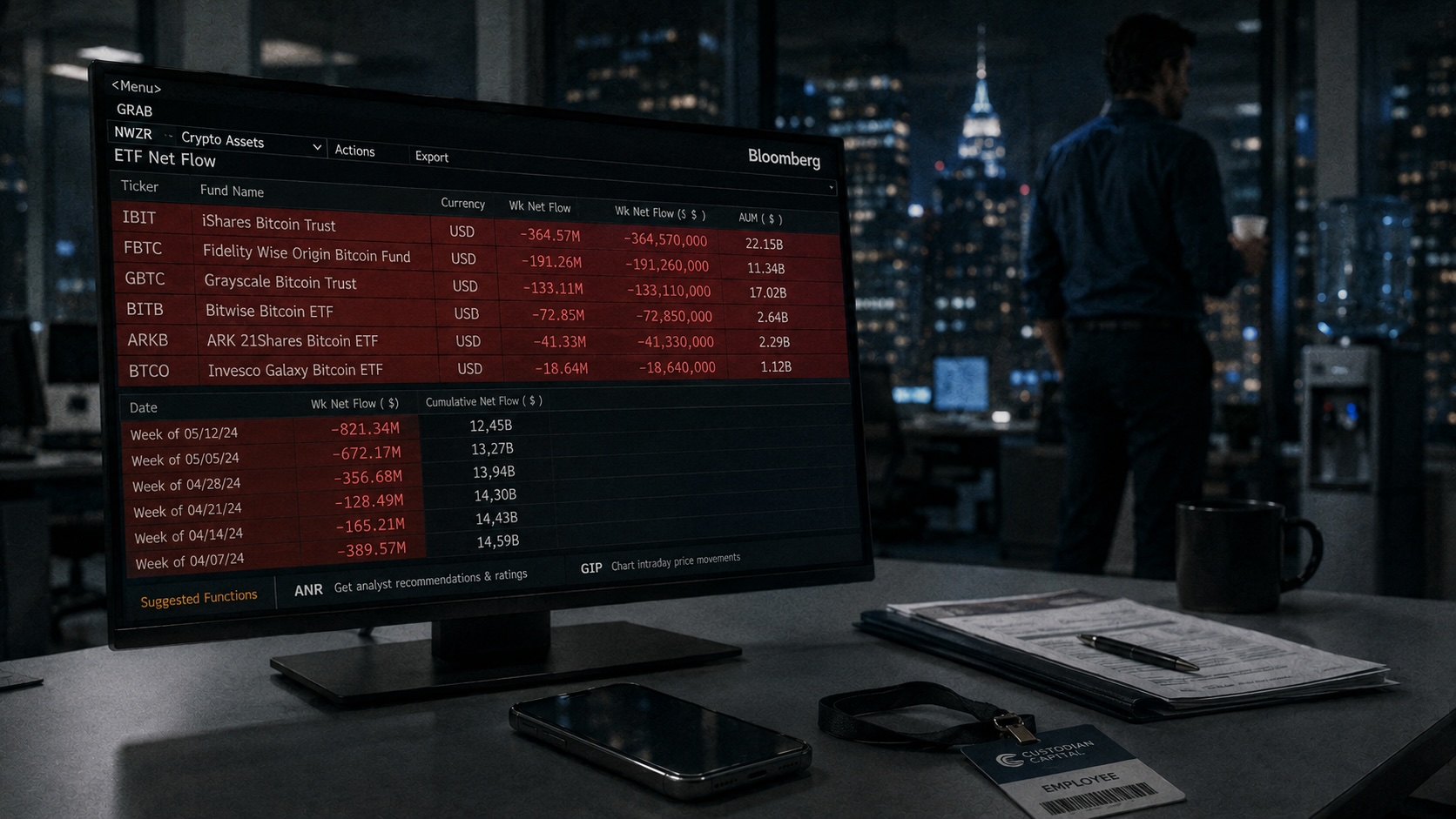
How Bitcoin ETF inflows and outflows affect holdings
Net flows for U.S. spot bitcoin ETFs track money entering and leaving funds and show how much bitcoin funds add or remove through creations and redemptions.
Investors track inflows and outflows to U.S. spot bitcoin ETFs as a direct measure of institutional demand. An inflow occurs when investors buy ETF shares and new capital enters a fund; an outflow occurs when investors sell shares and capital leaves. Net flow is the difference between inflows and outflows over a set period, most commonly a single trading day.
Creations and redemptions are the mechanisms that move actual bitcoin into or out of fund custody. If buying pushes an ETF’s market price above net asset value, authorized participants create shares by delivering cash or bitcoin to the issuer and the fund adds bitcoin to custody. If selling pushes the price below net asset value, authorized participants redeem blocks of shares and receive cash or bitcoin. Redemptions that settle in cash generally lead the fund to sell bitcoin on the open market; in-kind redemptions transfer bitcoin directly to the redeemer.
Flow figures are published after U.S. trading sessions and are commonly reported as daily net flow. Single-day net numbers can be volatile and can mask opposite activity across issuers. Analysts commonly smooth flows over a week and track reported holdings in bitcoin rather than dollars to remove the impact of price moves.
Spot ETF inflows are backed by actual bitcoin purchases, and sustained net inflows increase the total quantity of bitcoin held by funds. Redemption activity reduces fund holdings, and cash-settled redemptions may result in spot-market sales. Creation and redemption activity also adds trading volume in the underlying spot market and can affect liquidity and trading spreads on regulated exchanges.
Eleven U.S. spot bitcoin ETFs began trading in January 2024. BlackRock’s iShares Bitcoin Trust (IBIT) holds about half of the category’s assets and charges a 0.25% fee. Fidelity’s Wise Origin Bitcoin Fund (FBTC) is the second-largest fund, also charging 0.25% and custodying bitcoin through Fidelity Digital Assets. Grayscale’s GBTC converted from a closed-end trust into an ETF and carries a higher fee than many peers; some investors sold after the conversion closed a prior discount. Other larger funds include ARK 21Shares Bitcoin ETF (ARKB) and Bitwise Bitcoin ETF (BITB).
Reliable flow tracking uses issuer disclosures, fund fact sheets and official holdings reports. Assets under management reflects both flows and bitcoin price moves; holdings expressed in coins remove price effects. Aggregating daily flows into weekly or multi-day totals provides a clearer view of how much regulated capital is moving into or out of bitcoin through ETFs.
The content on The Coinomist is for informational purposes only and should not be interpreted as financial advice. While we strive to provide accurate and up-to-date information, we do not guarantee the accuracy, completeness, or reliability of any content. Neither we accept liability for any errors or omissions in the information provided or for any financial losses incurred as a result of relying on this information. Actions based on this content are at your own risk. Always do your own research and consult a professional. See our Terms, Privacy Policy, and Disclaimers for more details.
Articles by this author